Silver (amalgam) fillings: what to know
Amalgam is the silver filling made of mercury and other metals. UK guidance finds no evidence existing ones harm health, or reason to replace sound ones unless you react to them. Limits on new ones are environmental.
On this page
If you have silver-coloured fillings in your back teeth, you may have wondered whether the mercury in them is a problem, or whether they ought to come out. For most people with a sound filling, UK guidance says there is no health reason to replace it. The rules that now limit new amalgam fillings are mostly about the environment.
What is a silver (amalgam) filling?
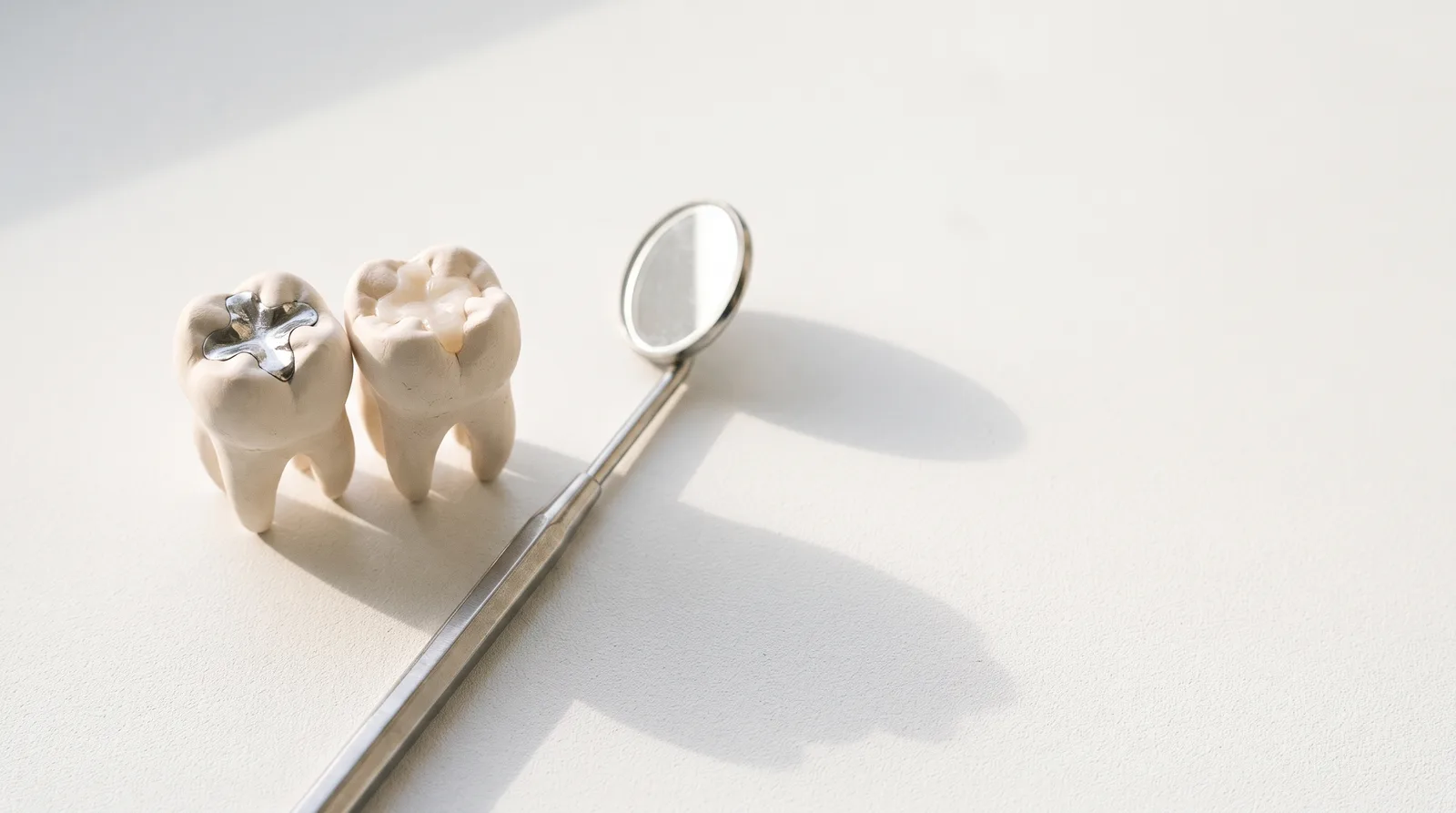
Amalgam is made by mixing mercury with silver, tin and copper, according to the NHS. The World Health Organization (WHO) says mercury makes up around half of it by weight. The Oral Health Foundation describes it as a strong, long-lasting material that has been used for more than 150 years, and says it is sometimes called a silver filling because of its colour.
It is one of several types of filling used in restorative dentistry. The NHS names white fillings alongside it, and says your dentist will offer the type that suits your clinical needs.
Are silver fillings safe?
The Scottish Dental Clinical Effectiveness Programme (SDCEP), part of NHS Education for Scotland, says there is no evidence that amalgam presents a direct health risk to people who have it. The British Dental Association (BDA) says the same in its February 2024 position paper: no evidence that mercury from amalgam fillings harms health.
A 2021 Cochrane review is the main trial evidence. Its two largest trials followed children aged 6 to 12, and two trials found higher mercury levels in the urine of children with amalgam, but lower than the level known to be toxic. The review found no consistent or clinically important harms. It rates this evidence as very low certainty, with most harms reported in only one trial.
An allergy to an ingredient in amalgam is very rare, the Oral Health Foundation says. WHO notes that mercury can be released when amalgam is placed or removed, particularly when proper safety measures are not in place.
Why are the rules on amalgam changing?
UK guidance gives the environment as the reason. SDCEP explains that mercury released into the environment can be converted by microorganisms into a form that builds up in fish and can enter the human food chain. The BDA says the UK, with more than 140 other countries, signed the Minamata Convention on Mercury, a global treaty that came into force in August 2017.
Since 1 July 2018 UK law has limited new amalgam fillings in some groups, SDCEP says, with the dentist deciding when amalgam is strictly necessary for a patient. It adds that the restrictions are not a result of safety concerns about amalgam fillings.
| Who | New filling | Existing filling |
|---|---|---|
| Children under 15 | Only if strictly necessary | No need to replace if sound |
| Pregnant | Only if strictly necessary | Removal avoided unless urgent |
| Breastfeeding | Only if strictly necessary | No need to replace if sound |
| Baby teeth, at any age | Only if strictly necessary | No need to replace if sound |
| Everyone else | Can be offered where justified | No need to replace if sound |
For the restricted groups, SDCEP says amalgam may still be the only workable choice in some cases, for example with an allergy to the alternatives or when the tooth cannot be kept dry enough. Avoiding amalgam in pregnancy has been accepted practice for many years as a precaution, SDCEP says, even though there is no evidence that amalgam fillings harm pregnant women or their babies.
Where is it heading?
The UK is a party to the Minamata Convention. In November 2025 the countries in the treaty agreed to phase out dental amalgam by 2034, according to WHO and the Department for Environment, Food and Rural Affairs (Defra). The Department of Health and Social Care told Parliament the same month that it is planning the steps to move towards and implement that phase-out.
As of October 2026 we could not find a detailed timetable for those steps. The 2018 limits in the table above still apply now, and amalgam can still be used for other patients. If you have questions about your own fillings, ask your dentist.
Do silver fillings need replacing?
Not usually. SDCEP says there is no reason to replace a clinically sound amalgam filling, except for someone with an allergy or a local reaction to it, and that removing a sound one can mean an unnecessary loss of tooth material. The Oral Health Foundation lists the reasons a dentist may replace one: it is damaged or worn, or it no longer seals the tooth properly. It adds that removal can briefly release mercury vapour and may weaken the tooth.
In pregnancy, SDCEP advises avoiding removal as a precaution, though it says removal is reasonable for urgent treatment, such as relieving pain or infection. It gives no such precaution for breastfeeding.
If you simply prefer the look of white fillings, the Oral Health Foundation says it is usually sensible to wait until the existing filling needs replacing, which protects the tooth.
How do amalgam and white fillings compare?
The Cochrane review compared tooth-coloured (composite) and amalgam fillings in permanent back teeth, mostly in two trials of 921 children. It found low-certainty evidence that composite fillings may be almost twice as likely to fail, and more likely to develop new decay around the filling, though not more likely to break. Its authors say the trials were quite old and composite materials have probably improved since.
On durability and looks, the Oral Health Foundation says amalgam usually lasts longer and wears better on back teeth, while white fillings blend in and are less noticeable when you smile. Which suits a particular tooth is a decision for you and your dentist.
When to see a dentist
A filling of any material can wear, chip or come loose. The NHS lists a loose or broken filling among the causes of toothache.
- Go to A&E if you have toothache and the area around your eye or your neck is swollen
- Go to A&E if you have toothache and swelling in your mouth or neck is making it difficult to breathe, swallow or speak
- Do not drive yourself: ask someone to drive you, or call 999 and ask for an ambulance
- If you do not have a dentist, or cannot get an emergency appointment, call 111 or use 111 online and they can advise you what to do
For anything less urgent, see a dentist.
- A filling that looks worn, damaged, loose or missing
- Toothache that lasts more than 2 days, or does not go away with painkillers
- Toothache with a high temperature, pain when you bite, red gums, a bad taste in your mouth, or a swollen cheek or jaw
- Concern that you may be reacting to a filling
Do not go to your GP about toothache, as the NHS says they cannot give dental treatment. While you wait for an appointment, ask your pharmacist about pain relief. The NHS says children under 16 should not take aspirin.
What we would do
On our fillings page we describe tooth-coloured composite and glass ionomer fillings. Composite blends in with your natural teeth. Glass ionomer releases fluoride and is sometimes used near the gumline or where bite pressure is lighter. Larger fillings are usually done under local anaesthetic, so the area is numbed first.
We check fillings at routine examinations and replace them if needed. If you have old silver fillings and want to talk them through, mention it at your next check-up, or book a new patient exam if you are new to us. A new patient exam covers your teeth, gums and soft tissues, with small X-rays if they are needed, and we talk through any options with you. To have a filling that worries you looked at, book an appointment.
Want us to take a look?
Book an appointment at whichever of our five practices suits you. We will check what is going on and talk you through your options.
Questions this guide answers
Are silver fillings safe?
The Scottish Dental Clinical Effectiveness Programme and the British Dental Association both say there is no evidence that amalgam fillings harm health. A 2021 Cochrane review found no consistent or clinically important harms, though it rates that evidence as very low certainty. If you are worried, ask your dentist.
Should I have my old silver fillings taken out?
Usually not. The Scottish programme sees no reason to replace a sound amalgam filling unless you have an allergy or a local reaction to it. The Oral Health Foundation adds that a worn or damaged filling, or one that no longer seals the tooth, may need replacing. Your dentist can check yours.
Why is amalgam restricted for children and in pregnancy?
Since 1 July 2018 UK law has limited amalgam for under-15s, for pregnant or breastfeeding women and for baby teeth, unless the dentist thinks it strictly necessary. The Scottish programme says the aim is to cut environmental mercury, not a safety concern about the fillings, and that avoiding amalgam in pregnancy has long been a precaution.
Is amalgam being banned in the UK?
Not at the moment. In November 2025 the UK government told Parliament it is planning to phase out dental amalgam by 2034, after countries in the global mercury treaty agreed to. Until then the 2018 limits still apply, and amalgam can still be used for other patients. Ask your dentist about your own fillings.
Sources (9)
- Dental treatments
- Toothache
- Restricting the use of dental amalgam in specific patient groups: discussion points
- Dental services: mercury, written question HL11704 (answered 14 November 2025)
- International environmental protection report (April 2024 to March 2026)
- Dental amalgam: BDA position paper, February 2024
- Amalgam fillings
- Direct composite resin fillings versus amalgam fillings for permanent posterior teeth
- Oral health care and the environment