What is a cavity? Causes and treatment
A cavity is a hole that tooth decay can leave in a tooth. Once there is a hole, the NHS says you will probably need a filling. Decay caught before a hole forms can be reversed. See a dentist rather than waiting.
On this page
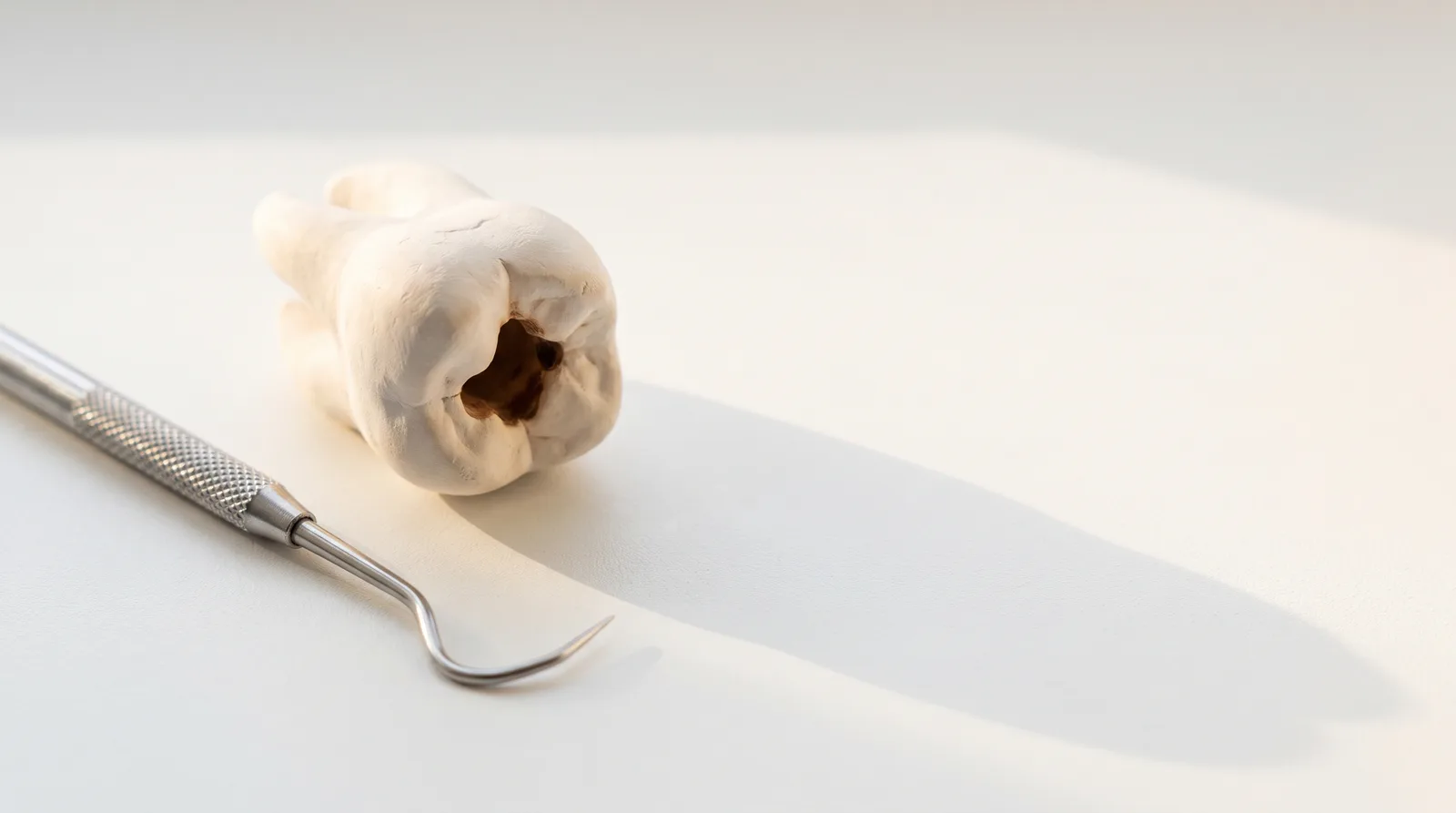
A cavity is a hole in a tooth. It is what tooth decay can leave behind, and decay may cause no symptoms at first. Decay that has not yet made a hole can be reversed, and a hole that has formed can be repaired.
Cavity or tooth decay: what is the difference?
You will see the problem called tooth decay, dental decay or dental caries. The Oral Health Foundation says these three terms mean the same thing. A cavity is the hole that decay can eventually create, so it is one stage of decay rather than a different problem.
How does a tooth get a cavity?
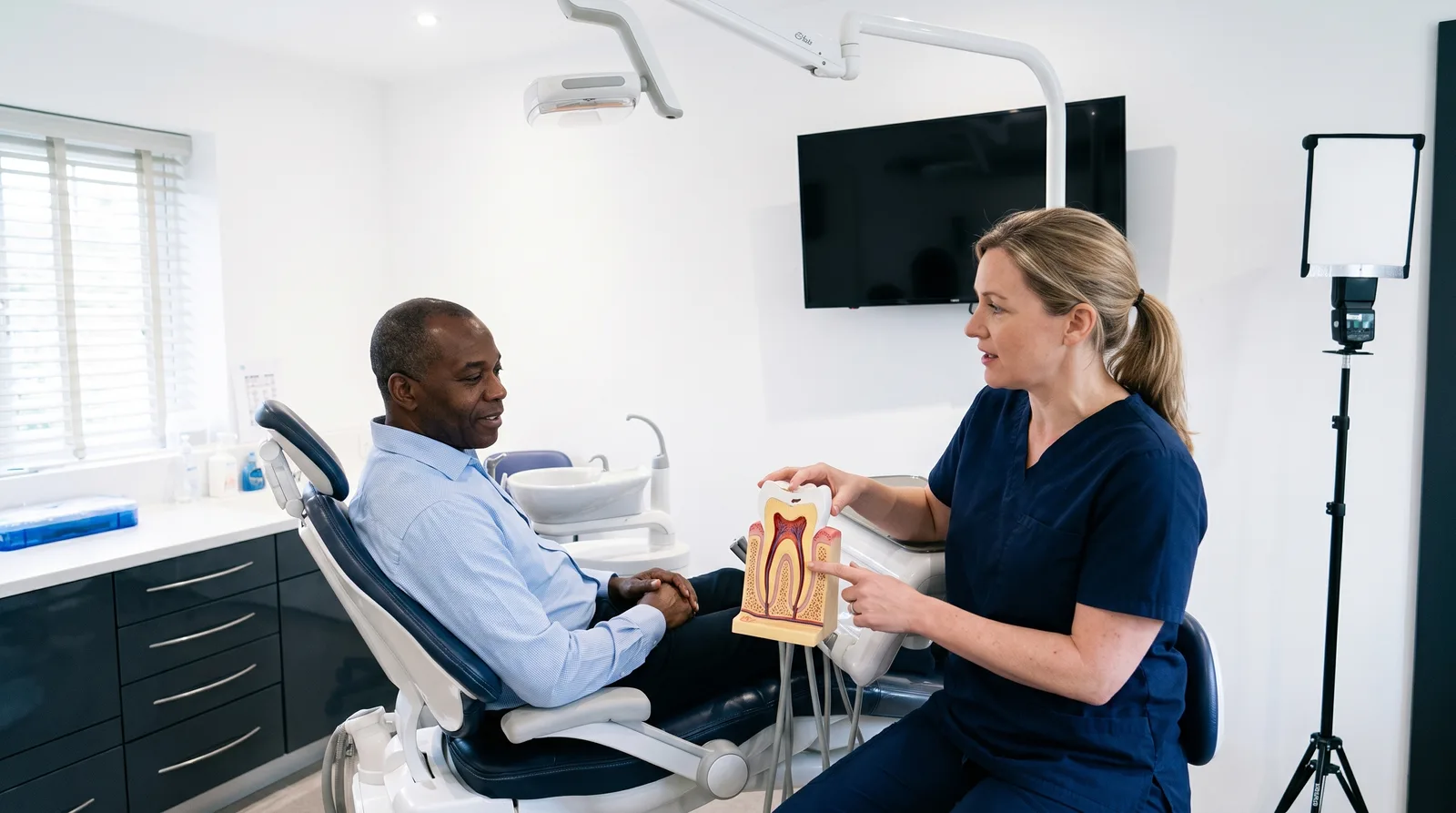
A tooth has three layers. Enamel is the hard outer coat, and it does not feel pain. Under it is dentine, which is softer and holds tiny nerve endings. At the centre is the pulp, where the nerves and blood vessels are.
Plaque, a sticky film of bacteria, forms on your teeth every day. When you eat or drink something sugary, the bacteria in plaque make acid. The Oral Health Foundation says each acid attack can last around an hour, and that the acid softens the tooth surface and slowly dissolves it.
Your saliva works against this. The Oral Health Foundation says it neutralises the acid and helps harden the enamel again, which helps repair early damage. The government toolkit Delivering better oral health, written for dental teams, describes minerals leaving the tooth and returning to it in an ongoing cycle. Decay moves forward when more is lost than returns. Left unchecked, it reaches the dentine, and eventually the surface breaks down and a cavity forms.
The toolkit names two main risk factors that can be changed: eating too much sugar too often, and too little fluoride. Sugar eaten often, especially between meals, leaves teeth little time to recover, the Oral Health Foundation says.
What can you notice, and what might a dentist do?
What you notice depends on how far decay has gone. The table follows the NHS and the Oral Health Foundation.
| Stage | What you may notice | What may be done |
|---|---|---|
| Early, in the enamel | Often nothing | Fluoride treatments, such as a mouthwash or varnish |
| A hole in the tooth | Toothache, sharp pain with hot, cold or sweet food or drink, or a white, brown or black spot | Probably a filling |
| Decay reaching the pulp | Pain that can be severe, sometimes with infection or an abscess | Root canal treatment, or sometimes removing the tooth |
Treat the table as a guide to what dentists describe, not a way to tell what you have. Only an examination shows that. Our guide to white spots on teeth covers other causes of white marks.
Does a cavity go away on its own?
Not usually. Once there is a hole, the NHS says you will probably need a filling. Decay that has not yet made a hole is different: the toolkit says it can be reversed in its early stages, with fluoride and less sugar, so it is still worth seeing a dentist rather than waiting. Untreated decay can lead to pain, infection or tooth loss, the Oral Health Foundation says.
How is a cavity found?
A dentist looks at your teeth and can use X-rays to see more. The Oral Health Foundation says X-rays can show decay hidden under the enamel, and may be suggested if a dentist suspects decay between teeth. The NHS says the gap between check-ups can be anywhere from 3 months to 2 years, or up to 1 year if you are under 18, depending on your oral health and risk.
How is a cavity treated?
Treatment depends on how far the decay has gone, the NHS says. For early decay, a dentist can prescribe fluoride treatments, such as a mouthwash or varnish, to reverse it. The toolkit describes the wider aim as reducing what causes minerals to be lost from the tooth, especially sugar, and increasing what helps them return, particularly fluoride.
Fillings
A filling repairs a hole caused by decay. The NHS says there are different types, including white fillings and amalgam, a mixture of mercury, silver, tin and copper, and that your dentist will offer the type that suits your clinical needs. White fillings are tooth-coloured. How long one lasts depends on where it is, its size, your bite and chewing habits, and how well you look after your teeth, the Oral Health Foundation says.
When a filling is not enough
If decay has reached the pulp, the NHS says you may need root canal treatment, which our guide to root canal treatment explains. The NHS says a crown, a cap that covers the whole tooth, can be fitted where a tooth has decayed or been damaged. If a tooth is badly damaged, removing it is sometimes necessary, the Oral Health Foundation says.
Who is more likely to get cavities?
Adults get cavities too: the toolkit says new decay can develop at any age. It says decay in the past is a good predictor of decay in future, and lists people who have decay now, children with decay in their baby teeth, some children and adults with medical conditions or disabilities, and older adults as being at higher risk.
Children’s teeth with hypomineralised enamel, which has less mineral than usual, are at increased risk, the toolkit says. Decay on the roots of teeth becomes more common with age, and it names poor plaque control, a dry mouth and exposed roots as signs of higher risk of root decay. Our guide to dry mouth explains why dryness matters.
Sugar in medicines can add to how often sugar reaches the teeth, the toolkit says. If you or your child take a liquid medicine regularly, ask your pharmacist or GP whether a sugar-free version is available.
Can cavities be prevented?
The toolkit calls decay largely preventable. The steps below come from the NHS and the Oral Health Foundation:
- Brush with fluoride toothpaste for two minutes last thing at night and at least once more in the day. Spit afterwards and do not rinse, the NHS says.
- Clean between your teeth every day with floss or interdental brushes.
- Have sugary food and drink less often. The Oral Health Foundation suggests keeping sugar to mealtimes. Our guide to sugar and your teeth goes into more detail.
- Ask your pharmacist or GP about sugar-free versions of medicines. The NHS also lists not smoking and not regularly drinking more than 14 units of alcohol a week.
- Go to check-ups as often as your dentist advises.
When to see a dentist
An infection that follows decay can become an emergency. The NHS dental abscess page says to call 999 or go to A&E if any of these apply.
- you find it hard to breathe, speak or swallow
- your eye is swollen or painful, or your eyesight suddenly changes
- you have a lot of swelling in your mouth
- you find it hard to open your mouth
Do not drive yourself. The NHS says to ask someone to drive you, or to call 999 and ask for an ambulance, and to bring any medicines you take.
Decay can also lead to a dental abscess, a build-up of pus caused by infection. The NHS lists intense toothache, a swollen face or jaw, a bad taste and a high temperature among the signs. If you think you have one, it says to ask for an urgent dentist appointment or get help from NHS 111, and not to go to a GP surgery, because they cannot give dental treatment. Our guide to tooth infection and abscess has more.
The NHS says to see a dentist as soon as possible if you think you or your child has tooth decay. Reasons to make an appointment include:
- toothache, or sharp pain when you eat or drink something hot, cold or sweet
- a white, brown or black spot on a tooth
- gums that are painful, swollen or bleed when you brush
- no check-up for 2 years, or for 1 year if you are under 18
Decay can cause no symptoms at first, which is why the NHS advises regular check-ups even when nothing hurts. If a tooth does hurt, our guide to toothache causes and when to get help covers the NHS advice for the time before you are seen.
What we would do
A new patient exam is the first step. We examine your teeth, gums and soft tissues, and take small X-rays where needed to check for decay between teeth or below the gumline. If treatment is recommended, we set out your options in plain language. If a tooth hurts and cannot wait, our emergency dentist page explains how to reach us.
If decay has made a hole, a filling repairs it. We check how far the decay goes, taking an X-ray if needed, then remove the decayed part, numbing the area first with local anaesthetic if needed. We build up a tooth-coloured composite in layers, shape it to your bite, polish it and check how it meets your other teeth before you leave. A filling is usually completed in a single visit, and we use glass ionomer for some fillings.
Where a filling cannot restore a tooth, your dentist can discuss a dental crown, root canal treatment or, if the tooth cannot be saved, a tooth extraction. Our dental hygiene appointments remove plaque and tartar and include brushing and flossing advice, and children’s dentistry covers younger patients.
Early is when decay is easier to treat, the Oral Health Foundation says, and regular visits help spot it. If it has been a while, or something hurts, you can book an appointment and your dentist will take a look.
Want us to take a look?
Book an appointment at whichever of our five practices suits you. We will check what is going on and talk you through your options.
Questions this guide answers
Is a cavity the same as tooth decay?
Not quite. The Oral Health Foundation says tooth decay, dental decay and dental caries all mean the same thing, and that a cavity is the hole decay can eventually create. So a cavity is one stage of tooth decay, not a separate condition.
Can a cavity go away on its own?
Not usually. Once there is a hole, the NHS says you will probably need a filling. Decay caught before a hole forms can be reversed, and the NHS says a dentist can prescribe fluoride treatments for it. Either way, see a dentist rather than waiting to see what happens.
Does a cavity always hurt?
No. The NHS says tooth decay may cause no symptoms at first, and the Oral Health Foundation says you may feel nothing while decay is still in the enamel. Once it reaches the dentine, teeth may become sensitive, and if it reaches the pulp, pain can become severe.
What happens if a cavity is left untreated?
The Oral Health Foundation says untreated decay can lead to pain, infection or tooth loss. The NHS says a tooth can become infected, forming a dental abscess, which needs urgent treatment from a dentist and will not go away on its own. Regular visits help spot decay when it is easier to treat.
Will I need a local anaesthetic for a filling?
It depends on the size and position of the filling. At TG’s Dental Suite, smaller fillings sometimes do not need one, while larger fillings are usually done under local anaesthetic, so the area is numbed before we begin.
How often should I see a dentist to catch cavities early?
The NHS says the gap between check-ups can be anywhere from 3 months to 2 years, or up to 1 year if you are under 18, depending on your oral health and your risk of future problems. Delivering better oral health says there is no evidence that one set interval changes how decay develops, and that the gap should be based on risk.