How smoking affects your mouth
Smoking raises the risk of gum disease, tooth loss and mouth cancer, stains teeth and can affect healing after surgery. Stopping lowers those risks. Free NHS help is available, and your dentist can talk it through.
On this page
If you smoke, you may already suspect it is hard on your mouth. What you may want to know is what it does to your teeth and gums, whether any of it can be undone, and where to start if you would like to stop.
What smoking does to your gums and teeth
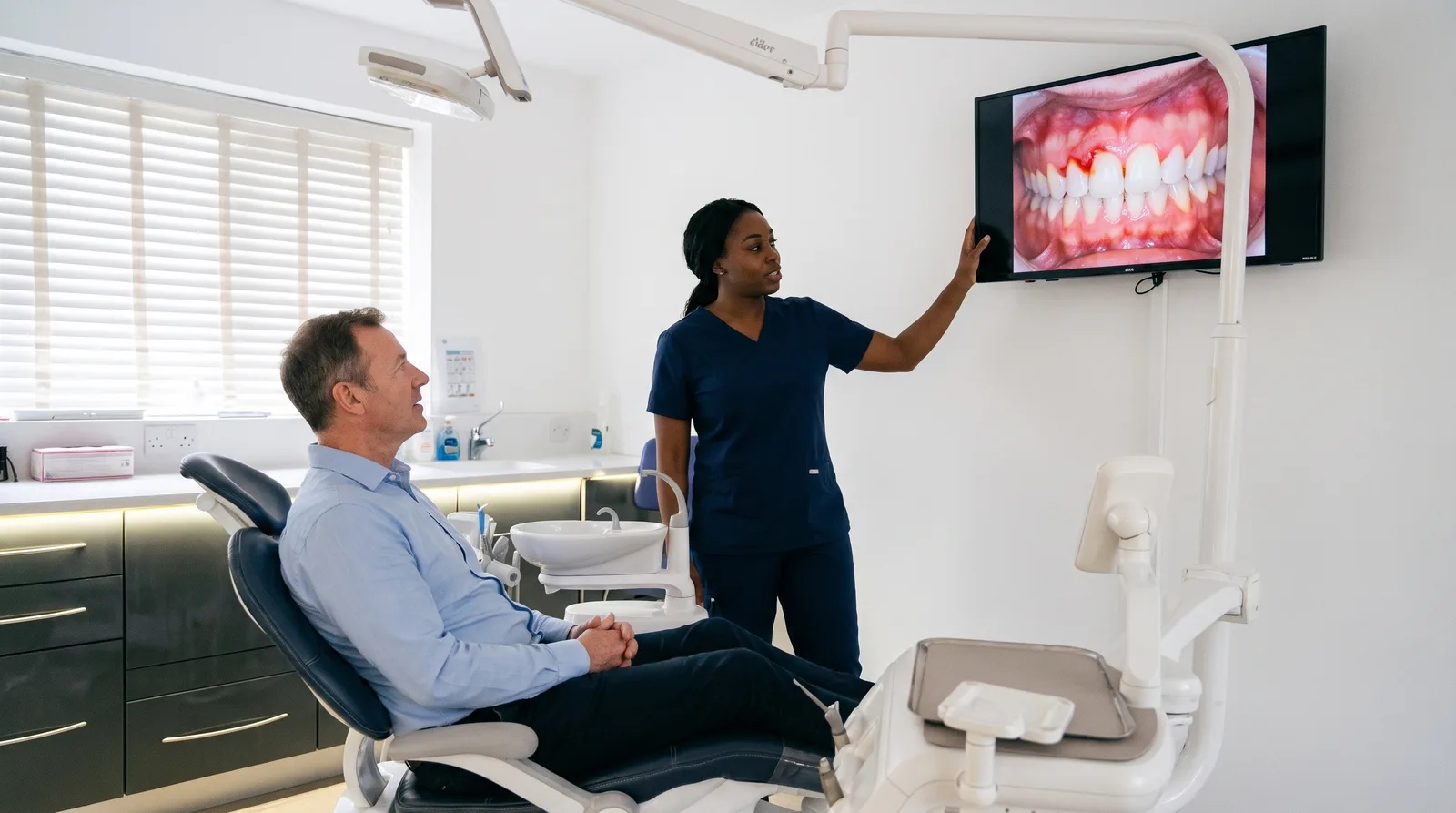
Gum disease starts with a build-up of plaque on the teeth, and the NHS says it is very common. Smoking raises the risk and the severity. The government’s guidance for dental teams, last updated in September 2025, lists more severe and widespread gum disease, tooth loss and poor healing after surgery among the main harms of tobacco in the mouth. ASH adds that periodontitis, the more serious form of gum disease, can lead to tooth loss and bone loss, and it lists tooth decay among the problems linked to smoking.
Studies put numbers on this. They describe groups of people, not what will happen to you, and estimates differ from study to study.
| Problem | Compared with | What the research found |
|---|---|---|
| Gum disease starting or getting worse | People who quit or never smoked | About 80 percent higher risk (2019 review of six studies) |
| Losing teeth | People who never smoked | About 2.6 times the risk (2019 review of long-term studies) |
Gum treatment also seems to work a little better once smoking stops. In the 2019 gum disease review, people who had quit had modestly better results after non-surgical gum treatment than people who had not, measured over 12 to 24 months. The authors say few studies were available.
Other forms of tobacco carry risks too. The government guidance says every form of tobacco that is legal in the UK carries a risk of oral cancer. Many people assume the water in a shisha pipe filters out the harm, but the guidance says shisha carries many of the same risks as cigarettes. ASH says the same of cigars and pipes. Chewed tobacco and paan have their own risks, covered in our guide to smokeless tobacco and paan.
Mouth cancer risk
Around 17 in 100 mouth cancers in the UK are caused by smoking, according to Cancer Research UK, using UK data from 2015. ASH’s 2025 fact sheet, drawing on a 2008 review, reports that people who smoke cigarettes have over three times the risk of mouth cancer compared with people who have never smoked. Cancer Research UK adds that drinking alcohol as well raises the risk further.
Dentists can spot early changes. Red or white patches in the lining of the mouth may, in some people, develop into cancer over some years. Cancer Research UK says dentists can spot these patches at appointments, which is why regular check-ups matter.
Staining, breath and taste
Stained teeth and bad breath are among the signs of tobacco use that the government guidance tells dental teams to look for, and ASH lists both too. The NHS says gum disease can also bring bad breath and a bad taste in the mouth. If a bad taste or changes to your tongue keep coming back, our guide to bad taste and tongue changes explains the common causes, and our guide to dry mouth covers a mouth that often feels dry.
The NHS says that 48 hours after you quit, your senses of taste and smell are improving.
Healing after dental treatment
Poor healing after surgery is one of the harms of tobacco in the mouth that the government guidance names. If you have an extraction, gum treatment or another procedure planned, mention that you smoke so your dentist can take it into account, and ask what they advise. UK guidance notes that some people stop for a while before an operation, so it is worth asking whether that would help in your case.
What changes when you stop
The NHS says it is never too late to quit. The research on the mouth is encouraging, though it has limits.
- Gums: in the 2019 review, people who had quit smoking had a risk of gum disease starting or getting worse that was not significantly different from people who never smoked. The review could include only six studies in its analysis.
- Teeth: a separate 2019 review found that former smokers had a lower risk of tooth loss than current smokers. ASH says it can take many years for that risk to fall to the level of someone who never smoked.
- Mouth cancer: ASH says stopping reduces the risk of oral cancer, and that some evidence suggests it may take at least twenty years to fall to that of people who never smoked.
The government guidance also says that many of the effects of tobacco on the mouth can be reversed, and that the benefits of stopping for your health in general begin almost immediately.
Getting support to stop
Most people who smoke would like to stop, and many make several attempts, according to UK guidance for dental teams.
The NHS Better Health quit smoking pages have free tools and practical advice, including a Personal Quit Plan and an app, and information on expert support. People who reach 28 days without smoking are 5 times more likely to quit for good, according to the same pages.
The government guidance says that people who combine specialist support with stop smoking aids are about three times as likely to quit successfully as people who try unaided or with over-the-counter nicotine replacement alone, and that local stop smoking support is free apart from any prescription charges. Vapes still carry some risk, but UK guidance says they are far less harmful than cigarettes and can help people stop smoking. Our guide to vaping and your mouth has more. A pharmacist or your GP can talk you through the options for stop smoking products and medicines.
If you are not ready, that is your choice. Dental teams are advised to tell you the same: help is there whenever you want it.
When to see a dentist
The NHS says to see a dentist about gum problems, and to see a GP about possible signs of mouth cancer, although a dentist can also help with ulcers, lumps, patches or pain in the mouth. These signs are very common and can have other causes, so having one does not necessarily mean you have cancer. It is still important to get checked, because finding cancer early may make it easier to treat.
- gums that bleed when you brush or eat hard foods, or that are red, swollen or sore
- bad breath that does not go away
- a mouth ulcer that has lasted more than 3 weeks
- a red or white patch, or a lump, in your mouth or on your lip
- a lump in your neck or throat
- pain in your mouth that is not going away, difficulty swallowing or speaking, or a croaky voice that does not clear
Ask for an urgent dentist appointment, the NHS says, if gum disease comes with very sore and swollen gums, teeth becoming loose or falling out, ulcers or red patches in your mouth, or a lump in your mouth or on your lip. Gum disease can lead to a dental abscess, a build-up of pus caused by infection, which needs urgent treatment by a dentist. If you do not have a dentist or cannot get an emergency appointment, call 111. The NHS also advises regular check-ups even when nothing is wrong, and seeing a dentist if you have not had one in 2 years (1 year if you are under 18).
Call 999 or go to A&E if you have a lot of swelling in your mouth, a swollen or painful eye, or you find it hard to breathe, speak, swallow or open your mouth. The NHS says not to drive yourself to A&E.
What we would do
If it is a while since your last check, we would start with a new patient exam. We examine your teeth, gums and soft tissues, screen for oral cancer and take small X-rays where needed. You can tell your dentist that you smoke, or that you are thinking about stopping. National guidance asks dental teams to talk this through and point people to stop smoking support.
If your gums need attention, a dental hygiene appointment begins with an assessment of your gum health, followed by a clean and scale and a polish, with advice on brushing and cleaning between your teeth. Where a gum pocket has not responded fully to cleaning alone, a perio chip can be placed alongside the clean. If staining bothers you, teeth whitening is assessed by your dentist first, to check it suits your teeth.
If you smoke and would like your mouth checked, book an appointment.
Want us to take a look?
Book an appointment at whichever of our five practices suits you. We will check what is going on and talk you through your options.
Questions this guide answers
Does smoking raise the risk of gum disease?
Yes. Government guidance for dental teams lists more severe gum disease among the main harms of tobacco in the mouth. A 2019 review of six studies found about an 80 percent higher risk of gum disease starting or getting worse in smokers than in people who quit or never smoked.
Is it worth stopping if I have smoked for years?
The NHS says it is never too late to quit. A 2019 review of six studies found that people who had stopped had a gum disease risk similar to people who never smoked. ASH says some risks, such as mouth cancer, can take many years to fall.
Where can I get free help to stop smoking?
NHS Better Health has free tools and advice, including a Personal Quit Plan and an app. Government guidance says people who combine specialist support with stop smoking aids are about three times as likely to quit as people who try on their own, and that local support is free apart from any prescription charges.
Will my dentist ask whether I smoke?
Guidance for dental teams says every patient should be asked about tobacco use as part of their health history, and asked again at later visits. If you are not ready to stop, the advice is to tell you that help is there whenever you want it.
Can a dentist help with stains from smoking?
Staining is one of the signs of tobacco use that guidance tells dental teams to look for. Professional whitening is designed to lighten staining, including staining linked to smoking, and your dentist assesses whether it suits your teeth first.
Sources (9)
- Quit smoking
- Gum disease
- Symptoms of mouth cancer
- Delivering better oral health: an evidence-based toolkit for prevention, chapter 11: smoking and tobacco use
- Risks and causes of mouth and oropharyngeal cancer
- Smoking and other health conditions (ASH fact sheet, August 2025)
- Impact of smoking cessation on periodontitis: a systematic review and meta-analysis of prospective longitudinal observational and interventional studies
- Effect of smoking cessation on tooth loss: a systematic review with meta-analysis
- Dental abscess