Diabetes and your mouth
Diabetes can raise the risk of gum disease, and gum disease and blood sugar are linked in both directions. Dry mouth and thrush are also more likely. Brushing, cleaning between teeth and regular check-ups help.
On this page
NICE guidance for adults with type 2 diabetes says your yearly diabetes review should include advice that you are at higher risk of periodontitis. That is the more serious form of gum disease, and NICE talks about it alongside eye and foot problems. Diabetes UK says looking after your teeth and gums is an important part of managing diabetes. It also points out that dental checks are not part of routine diabetes screening, so a dental check is yours to book. Other conditions can affect your teeth and gums too, as our guide to health conditions and your teeth explains.
Why diabetes affects your mouth
Diabetes UK explains how this happens. Diabetes can raise the amount of glucose in your saliva. That can feed bacteria that mix with food to form plaque, the sticky film that contributes to both gum disease and tooth decay. Living with diabetes, and some diabetes medicines, can also mean you make less saliva. Saliva helps protect your teeth and gums, so having less raises the risk of decay and tooth wear.
If you treat low blood sugar (a hypo) with fizzy drinks or sweets, the sugar can still reach your teeth, as our guide to sugar and your teeth explains. Always treat the hypo first, in the way your diabetes team has shown you. Once you feel better, Diabetes UK suggests rinsing your mouth with water or mouthwash, or brushing your teeth. If you brush, spit out the toothpaste rather than rinsing. Diabetes UK says this is especially important at night, when your body naturally makes less saliva. If you have hypos often or at night, talk to your GP or diabetes team.
Gum disease and blood sugar
Diabetes UK explains that gum disease starts as gingivitis, where only the gums are inflamed and the damage can be reversed. If it reaches the bone under the gums it is called periodontitis, which cannot be reversed and can lead to tooth loss. In the early stages it usually does not hurt, so you may not notice it.
Researchers describe the link as running in both directions. A 2024 summary of a European consensus report, from the European Federation of Periodontology and WONCA Europe (the European arm of the World Organization of Family Doctors), says:
- poorly controlled diabetes is associated with a higher risk and greater severity of periodontitis
- severe periodontitis is associated with higher HbA1c, the test used to measure blood sugar control, in people with diabetes and in people without it
- people with periodontitis have a higher risk of developing pre-diabetes and diabetes
These are associations found in studies. NHS England says the greater risk of periodontitis applies to both type 1 and type 2 diabetes. The consensus summary notes that most studies of the link have focused on type 2 diabetes, with minimal information for type 1.
Does treating gum disease lower blood sugar?
A 2022 Cochrane systematic review looked at this. It included 35 trials with 3,249 people who had both diabetes and periodontitis, almost all with type 2 diabetes. The treatment was professional removal of plaque and hard deposits from below the gumline, often called deep cleaning, compared with no treatment or usual care.
On average, HbA1c was 0.43 percentage points lower 3 to 4 months after treatment (30 trials, 2,443 people; the range of uncertainty was 0.28 to 0.59 points lower). The reviewers rated the certainty of this as moderate and called the change clinically significant. At 6 months the average fall was 0.30 points across 12 trials. At 12 months it was 0.50 points, but that came from a single trial of 264 people.
The review has limits. The trials lasted 3 to 12 months, and most did not measure side effects. Those that did generally reported none or only mild ones. Most trials were run in hospitals, and many had weaknesses in how they were done, though the results were consistent from trial to trial. The 2024 consensus says longer-term results would be desirable. NICE guidance for type 2 diabetes also says that managing periodontitis can improve blood glucose control. Gum treatment is not a replacement for your diabetes medicines, so do not change them without talking to your diabetes team, who also set your blood sugar targets.
Dry mouth, thrush and other problems
Gum disease is the most common diabetes-related mouth problem, according to Diabetes UK, but not the only one.
| Problem | You may notice | Start with |
|---|---|---|
| Dry mouth | Dryness, more decay | Pharmacist, then GP |
| Thrush | White coating, soreness | Pharmacist, then GP |
| Sore mouth, dentures | Trouble wearing them | Dentist |
| Abscess | Swelling, pain, a bad taste | Urgent dentist or NHS 111 |
Dry mouth
The NHS says a dry mouth is rarely a sign of anything serious, and adds that one that does not go away may be caused by a condition such as diabetes. It also says you are more likely to get tooth decay with a dry mouth. A pharmacist can suggest gels, sprays, tablets or lozenges. If you think a medicine is the cause, speak to your GP or pharmacist: the NHS says not to stop a prescribed medicine without medical advice first. Our guide to dry mouth covers causes and what helps in more detail.
Thrush
Oral thrush is a fungal infection, and Diabetes UK lists it among the problems more likely with diabetes. It suggests asking a pharmacist, who may recommend a special mouthwash or medication. If treatment has not helped, or you have sore white patches in your mouth, see your GP. If you wear dentures, a build-up of fungus on them can lead to thrush under them, so clean them regularly and take them out at night.
Healing after gum treatment
The 2024 consensus says high blood sugar can compromise healing after gum treatment. Your dentist can tell you what that means for your own treatment.
Looking after your mouth
- Brush twice a day with fluoride toothpaste, and clean between your teeth every day. The NHS says to spit after brushing and not to rinse. Diabetes UK also suggests brushing after meals, so ask your dental team which suits you.
- With receding gums or gaps between your teeth, Diabetes UK suggests interdental brushes rather than floss, and asking your dentist to show you how.
- Aim to keep your blood sugar within the target your diabetes team has agreed with you. Diabetes UK says this is a big part of lowering your risk of dental problems, and the consensus says better control improves the results of gum treatment. Your diabetes team will tell you whether and how often to check it.
- Have regular check-ups, and mention your diabetes when your dentist asks about your general health, as the NHS says they should. NICE advises adults with type 2 diabetes to have regular oral health reviews, with the dental team saying how often. Dental checks are not part of routine diabetes screening, Diabetes UK points out, so you book your own.
- Diabetes UK also lists a healthy, balanced, low-sugar diet, being active and not smoking, or getting help to stop, as ways to lower your risk. Our guide to smoking and your mouth has more. Questions about food are for your diabetes team.
When to see a dentist
Diabetes UK says to make an appointment with your dental team if you notice signs like these, and that early treatment can prevent severe infections and tooth loss.
- bleeding, tender, swollen or shrinking gums
- bad breath
- teeth that feel loose, or new gaps between your teeth
- toothache, pain when you chew, or sensitivity to hot or cold food and drink
The NHS says to ask for an urgent dentist appointment if gum disease comes with other symptoms: very sore and swollen gums, teeth becoming loose or falling out, ulcers or red patches in your mouth, or a lump in your mouth or on your lip. If you do not have a dentist, or cannot get an emergency appointment, the NHS says to call 111.
For a dry mouth, the NHS advises seeing a GP if home or pharmacy treatments have not helped after a few weeks. It also advises seeing a GP if it makes talking or eating difficult, or comes with other symptoms, such as needing to pee a lot or dry eyes.
Diabetes UK lists abscesses among the problems more likely with diabetes. An abscess is a build-up of pus in a tooth or the gum caused by an infection. The NHS says it needs urgent treatment by a dentist and will not go away on its own. If you think you have one, ask for an urgent dentist appointment or get help from NHS 111. Do not go to a GP surgery, because it cannot give you dental treatment. Our emergency dentist page has details of urgent care at our practices.
The NHS says any of the signs below means calling 999 or going to A&E.
- you find it hard to breathe, speak or swallow
- you have a swollen or painful eye, or your eyesight suddenly changes
- you have a lot of swelling in your mouth
- you find it hard to open your mouth
What we would do
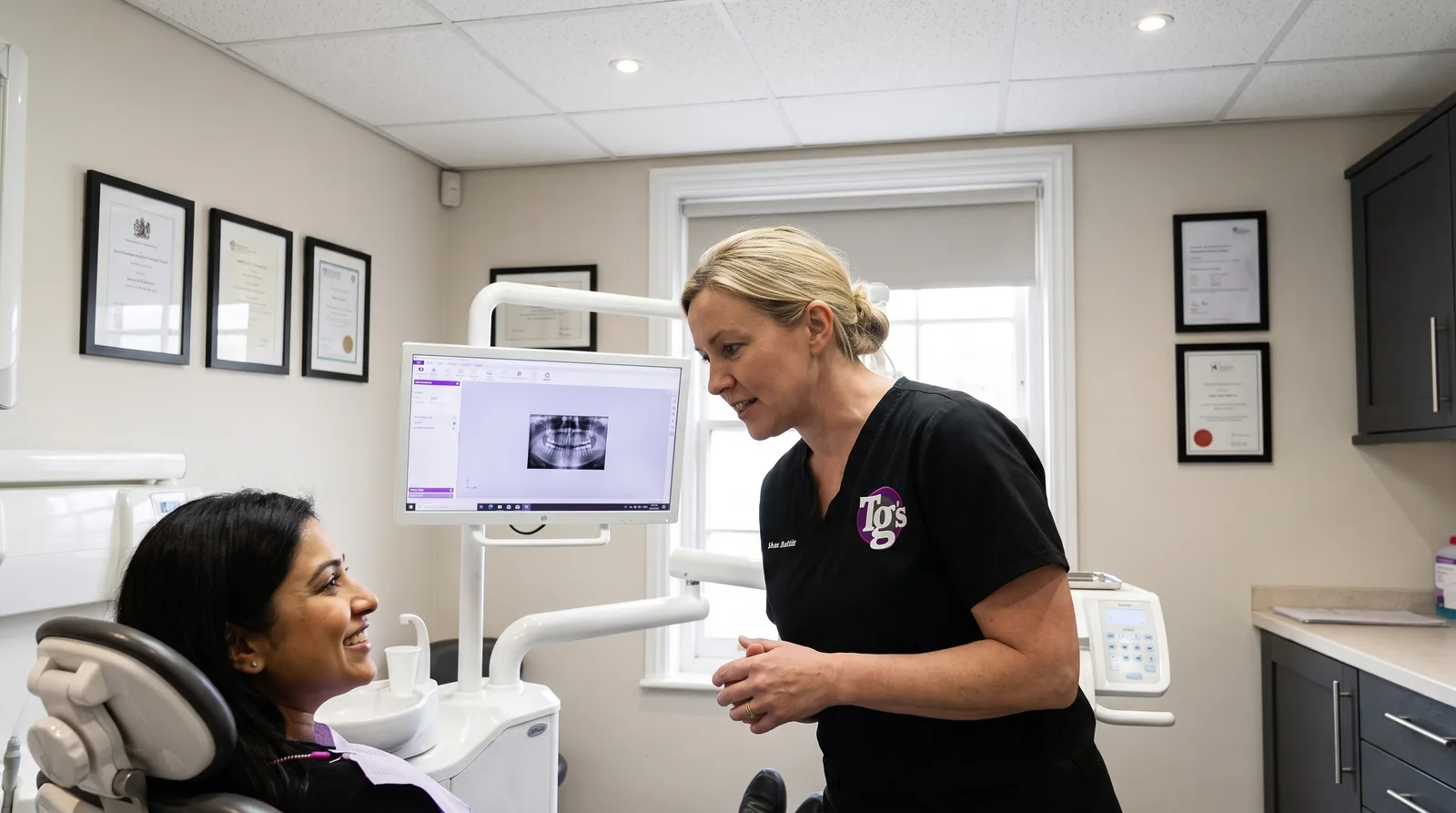
At a new patient exam, you fill in a short health history form before you are seen, which is the place to mention your diabetes. Your dentist then examines your teeth, gums and soft tissues, with small X-rays where needed, and explains any options.
A dental hygiene appointment starts with your hygienist checking your gum health and looking for plaque build-up and early signs of gum disease. They clean and scale your teeth, finish with a polish, and advise you on brushing and flossing. Your dentist or hygienist will tell you if you need more than a routine clean. These are our standard appointments rather than a diabetes-specific service.
To have your mouth checked, book an appointment and mention your diabetes.
Want us to take a look?
Book an appointment at whichever of our five practices suits you. We will check what is going on and talk you through your options.
Questions this guide answers
Why does diabetes make gum disease more likely?
Diabetes UK says diabetes can raise the sugar in your saliva, which feeds the bacteria that form plaque, and that having diabetes can increase the risk of gum disease. A European consensus links poorly controlled diabetes with a higher risk and greater severity of periodontitis.
Can treating gum disease improve my blood sugar?
A 2022 Cochrane review included 35 trials. Pooling 30 of them, it found moderate-certainty evidence that deep cleaning below the gumline lowered HbA1c, a measure of blood sugar control, by 0.43 percentage points on average after 3 to 4 months, compared with no treatment or usual care. Most people in the trials had type 2 diabetes. Gum treatment is not a replacement for diabetes medicines, and questions about your own blood sugar are for your diabetes team.
Is a dry mouth a sign of diabetes?
The NHS says a dry mouth is rarely a sign of anything serious, but one that does not go away may be caused by a condition like diabetes or Sjögren’s syndrome. It advises seeing a GP if home or pharmacy treatments have not helped after a few weeks, or if you have other symptoms such as needing to pee a lot.
Should I tell my dentist that I have diabetes?
It is sensible to. The NHS says your dentist should ask about your general health at a check-up, and Diabetes UK says regular dental check-ups are part of looking after your teeth and gums when you have diabetes. New patients at TG’s Dental Suite fill in a short health history form before they are seen, which is the place to say so.
How often should I see a dentist if I have diabetes?
Diabetes UK says your dentist should tell you how often, based on their assessment of your teeth and mouth. The NHS says the gap between check-ups can be as short as 3 months or as long as 2 years, depending on your oral health and your risk of future problems.
Sources (9)
- Diabetes and teeth, gum and mouth problems
- Type 2 diabetes in adults: management (complications, periodontitis)
- Gum disease
- Dry mouth
- Dental check-ups
- Commissioning standard: dental care for people with diabetes
- Treatment of periodontitis for glycaemic control in people with diabetes mellitus
- Periodontal diseases and cardiovascular diseases, diabetes, and respiratory diseases: summary of the consensus report by the European Federation of Periodontology and WONCA Europe
- Dental abscess