Sugar and teeth: how to cut down
Bacteria in plaque turn sugar into acid, which can lead to decay. Both how much sugar you have and how often you have it matter. UK advice is to keep free sugars to no more than 5 percent of your daily energy.
On this page
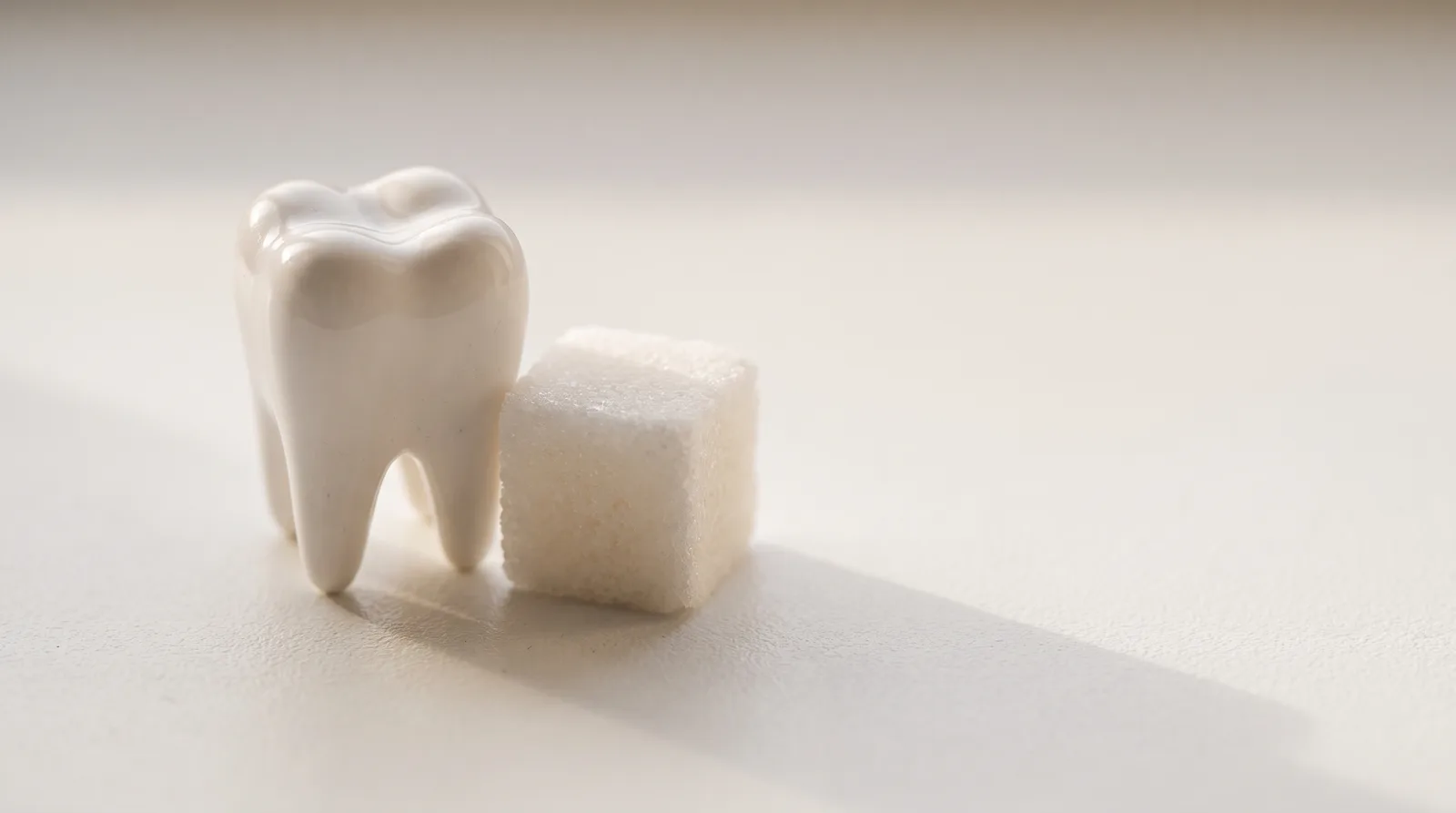
You have probably heard that sugar is bad for your teeth, and wondered how much is too much, or whether the sugar in your tea really matters. Most adults and children in the UK eat more of the kind of sugar that harms teeth than government advice allows. The changes below are small and practical, and none of them asks you to give up sweet things altogether.
How does sugar damage your teeth?
Plaque is a film of bacteria that coats your teeth. When you eat or drink something sugary, those bacteria turn the sugar into acid, and the acid pulls minerals out of the tooth surface. Over time this can lead to tooth decay, and the NHS names sugar as one of its main causes.
Acid levels in plaque rise within about a minute of eating sugar. Your saliva then slowly restores the balance, which the government’s oral health toolkit says takes 20 to 40 minutes. If you have more sugar before that happens, your teeth stay exposed to acid for longer. When sweet things are spaced some hours apart, the tooth surface has a good chance to recover, and fluoride helps that repair along.
Saliva flow is stimulated at mealtimes and much lower during sleep. That is why the toolkit advises avoiding sugary food and drink at bedtime.
Does it matter how much or how often?
Both matter. The toolkit advises cutting down the amount and the frequency of sugary food and drink. The Scientific Advisory Committee on Nutrition (SACN) reviewed the research in 2015. It linked a higher amount, and a higher frequency, of sugary food and drink with more tooth decay in children and teenagers. Some studies on frequency found no link, which SACN said may partly reflect how eating is measured. It also found less research on adults, but said decay develops in the same way.
The NHS advice is plain: keep foods and drinks with free sugars to mealtimes, rather than spreading them through the day.
How much sugar is too much?
The sugars the NHS says to cut down on are called free sugars. These are:
- sugars added to food or drink, such as in biscuits, chocolate, flavoured yoghurts, breakfast cereals and fizzy drinks
- sugars in honey, syrups, unsweetened fruit juice, vegetable juice and smoothies
- all sugars in alcoholic drinks, and the sugars in dairy-alternative drinks such as soya, rice, oat and nut-based drinks, according to the government oral health toolkit
Sugar found naturally in milk, and in whole fruit and vegetables, does not count as free sugars. Whole fruit is less likely to cause decay, the NHS says, because its sugars are contained within the fruit. Once fruit is juiced or blended into a smoothie, the sugars are released and can damage teeth.
Government advice is that free sugars should make up no more than 5 percent of the energy you get from food and drink each day. In grams, the NHS and the government oral health toolkit give these daily limits:
| Age | Free sugars a day |
|---|---|
| 1 | 10g, about 2 and a half sugar cubes |
| 2 to 3 | 14g, about 3 and a half sugar cubes |
| 4 to 6 | 19g, about 5 sugar cubes |
| 7 to 10 | 24g, about 6 sugar cubes |
| 11 and over, including adults | 30g, about 7 sugar cubes |
There is no guideline limit for babies under 1, but the NHS says sugars should not be added to their food or drinks.
For a sense of scale, the NHS says a can of cola can contain as much as 9 sugar cubes, which is more than the daily limit for adults. The average person is over the limit: the toolkit reports that in 2016 to 2019, adults aged 19 to 64 took an average of 9.9 percent of their energy from free sugars. The NHS also links too much sugar to weight gain, which is a second reason some people choose to cut down. If you have diabetes, our guide to diabetes and your mouth covers what matters for your teeth and gums.
Ways to cut down
SACN advises that sugar-sweetened drinks should be kept to a minimum, for children and adults, so drinks are a sensible first step. You do not have to change everything at once.
Drinks
- Swap sugary fizzy drinks and squash for water, lower-fat milk, or sugar-free, diet or no-added-sugar drinks.
- If you like fizz, try diluting no-added-sugar squash with sparkling water.
- Even unsweetened fruit juice and smoothies are sugary. The NHS advises no more than 150ml a day in total, taken with meals.
- If you take sugar in tea or coffee, reduce it gradually until you can cut it out, or switch to a sweetener.
- For children, the NHS says sugary squash, fizzy drinks and juice drinks should not be part of the daily diet. Water, lower-fat milk or sugar-free drinks are the swaps. Our guide to oral health and your children is written for parents.
Food
- Check the “of which sugars” line on the back of the pack. The NHS counts 5g or less per 100g as low and more than 22.5g per 100g as high. The figure includes sugar from milk and fruit, so it is a guide for comparing products rather than a count of free sugars.
- Look at the ingredients list. Sugar near the top suggests a lot of added sugar, and it goes by other names, including glucose, fructose, honey and syrups.
- For breakfast, the NHS suggests unsweetened wholegrain cereal with fruit added for sweetness.
Timing
- Keep sweet foods to mealtimes. Dried fruit is better eaten as part of a meal than as a snack between meals, according to the NHS.
- For a snack between meals, the toolkit recommends fresh fruit, frozen fruit or fruit canned in juice rather than in syrup.
- Avoid sugary food and drink last thing at night, then brush before bed.
- The NHS advises using sugar-free medicines. Your pharmacist can tell you whether a sugar-free version of a medicine exists. Do not stop a medicine you have been prescribed without asking your pharmacist or doctor.
What about sweeteners?
The NHS says lower and no calorie sweeteners can help you reduce the sugar you eat. It also says that using no calorie sweeteners in food and drink that contains no sugars can help reduce the risk of tooth decay. Fizzy drinks are a separate point. The NHS links them to dental erosion, which is tooth wear caused by acid, whether or not they contain sugar.
Cutting down is one part of looking after your teeth
The toolkit says changing your diet should work alongside fluoride, not replace it. The NHS advises brushing with fluoride toothpaste twice a day for about 2 minutes, last thing at night and on one other occasion. Spit out the excess afterwards rather than rinsing, because rinsing washes away the fluoride. Cleaning between your teeth every day is advised too.
What if decay has already started?
The NHS says treatment for tooth decay depends on how severe it is. A dentist can prescribe fluoride treatments like mouthwash or varnish to reverse early decay, and you will probably need a filling if there is a hole in the tooth. If decay has reached the soft tissue in the middle of the tooth, you may need root canal treatment. Sometimes the tooth has to be removed.
When to see a dentist
The NHS says tooth decay may not cause any symptoms at first, so a tooth that feels fine can still be worth having checked.
- toothache, or a sharp pain when eating or drinking something hot, cold or sweet (our guide to sensitive teeth has more)
- white, brown or black spots on a tooth, or a hole in a tooth
- gums that are painful, swollen or bleed when you brush
- no check-up for 2 years, or for 1 year if you are under 18
Your dentist can tell you how often you need a check-up.
A swollen face or jaw, intense pain, or a high temperature can be signs of a dental abscess. The NHS says a dental abscess will not go away on its own, and that a GP surgery cannot give dental treatment. Ask for an urgent dentist appointment or get help from NHS 111.
If you notice any of the signs below, the NHS says to call 999 or go to A&E.
- you find it hard to breathe, speak or swallow
- your eye is swollen or painful, or your eyesight suddenly changes
- there is a lot of swelling in your mouth
- you find it hard to open your mouth
What we would do
Your first step, particularly if it has been a while, is a new patient exam. We examine your teeth, gums and soft tissues, and take small X-rays where needed to check for decay between teeth or below the gumline. If a tooth has a hole, a filling repairs it with tooth-coloured composite. Decay that has gone further, into the nerve of the tooth, may need root canal treatment, which is designed to clear the infection and save the tooth. If a tooth is too damaged to save, a tooth extraction may be needed. Your dentist will explain which applies to you.
A dental hygiene appointment removes plaque and tartar that a toothbrush cannot reach, and includes professional advice on your own brushing and flossing routine.
To have your teeth checked for decay, book a check-up.
Want us to take a look?
Book an appointment at whichever of our five practices suits you. We will check what is going on and talk you through your options.
Questions this guide answers
How much sugar is too much for adults and children?
UK government advice is that free sugars should make up no more than 5 percent of the energy you get from food and drink each day. For adults, the NHS puts that at 30g a day, roughly 7 sugar cubes, and the government oral health toolkit gives the same limit from age 11. Younger children have lower limits, set out in the table in this guide.
Is fruit bad for my teeth?
The NHS says the sugars in whole fruit are less likely to cause decay because they sit inside the structure of the fruit. Juice and smoothies release those sugars, so the NHS advises no more than 150ml a day in total, taken with meals.
Are sugar-free drinks better for my teeth?
For decay, they can be. The NHS says using no calorie sweeteners, in a product that contains no sugars, can help reduce the risk of tooth decay. But fizzy drinks are acidic, and the NHS links them to dental erosion whether or not they contain sugar. Plain water has neither sugar nor acid.
Should I have sweet things with meals or between them?
The NHS advises keeping foods and drinks with free sugars to mealtimes. The government oral health toolkit adds that sugary food and drink should be avoided at bedtime, because saliva flow is reduced during sleep.