Invisalign: what to expect, month by month
Most Invisalign courses at our practices run nine to twelve months, though a case can take anywhere from six to eighteen. You wear each aligner at least 22 hours a day, change to the next one every week or two, and see us every four to six weeks.
A year is a long time to commit to something you have to think about twice a day. Nothing dramatic happens in any given week of Invisalign treatment, which is exactly why it helps to see the whole shape of it before you start. Here is what the months actually look like.
Before you start: the scan
The first consultation is free, secured with a deposit of £25. We take a digital 3D scan with our iTero scanner, and that scan builds a treatment plan showing where your teeth would end up and roughly how long it would take to get there.
This matters more than it sounds. You see the projected result before you have paid for a single aligner, so the decision in front of you is an informed one and not a hopeful one. If the plan does not convince you, that is a perfectly good place to stop.
Month one: the adjustment
Your first set of aligners arrives and the routine starts. Each one is worn at least 22 hours a day. In practice that means they come out for eating, for drinking, and for cleaning your teeth, and go back in afterwards.

Expect some tightness for a day or two after each new aligner goes in. It is not painful, but you will notice it, and it fades as the teeth settle into the position that aligner is asking for. The first fortnight is also when most people work out their own version of the habit: where the case lives, and when they take them out at work without making a moment of it.
Months two to four: the rhythm
By now the routine has stopped being a decision. You move to the next aligner every one to two weeks, and you see us every four to six weeks so we can check that the teeth are tracking the way the plan expected and hand over the next sets.
Those reviews are short. They are also the point at which a course that has drifted gets caught early, which is why they are not optional.
Months five to nine: the middle
This is the least eventful and most important stretch. The changes between one aligner and the next are small by design. Progress is easiest to see against where you started, not against last month.
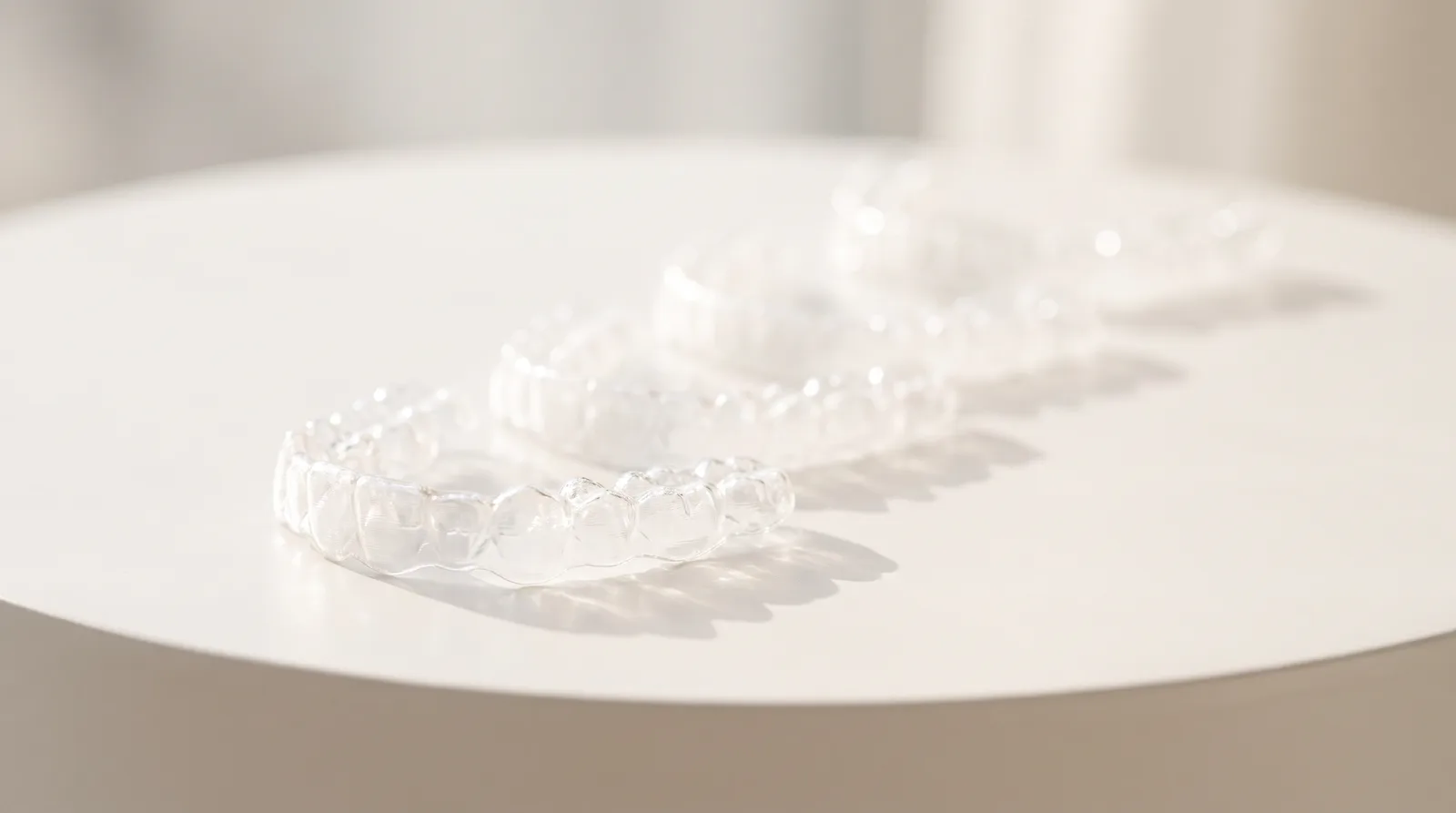
The aligners are close-fitting and virtually invisible, made from a medical-grade, FDA-approved material called SmartTrack, so most people around you will not know you are wearing them. That is usually what patients value most about the middle stretch. Nobody at work asks about it.
The last aligner, and after
Most courses finish somewhere between nine and twelve months. Depending on what the case needs, treatment can run from six months to eighteen. Hold onto the estimate you were given at the scan; it was made from your teeth, not from an average.
Then comes the part people underestimate. Teeth move back. A retainer, worn as we advise, is what keeps the result you have just spent a year earning. It is not an add-on to the treatment; it is the last stage of it.
If clear aligners are not the right fit, they are not the only option. We also provide SmileTRU clear positioners and fixed braces, and which one suits you is a conversation, not a default.