Dental X-rays: purpose and safety
Dentists use X-rays to see what a mouth examination cannot, such as decay between teeth or infection at a root. The dose is very small, and an X-ray should only be taken when its benefit outweighs the risk.
On this page
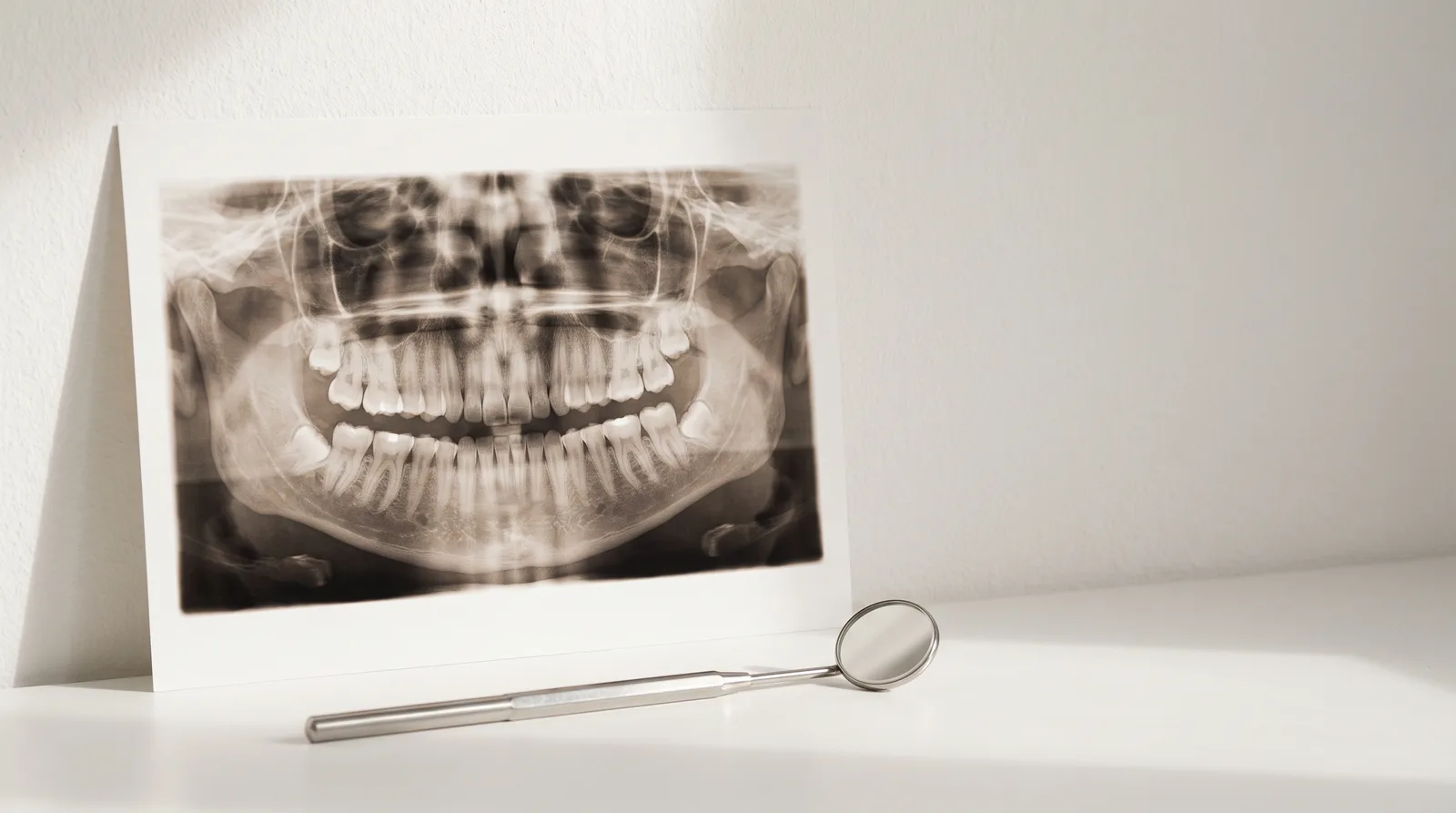
Your dentist suggests an X-ray, and questions follow. Is it needed, how much radiation is involved, and will you be offered one at every visit? An X-ray shows what a look in the mouth cannot: the inside of a tooth, its roots and the bone around it.
What can a dental X-ray show?
The Oral Health Foundation says X-rays help find problems that cannot be spotted by looking, including decay hidden under the enamel, infection at the root of a tooth and bone lost to gum disease. NHS inform adds impacted teeth, jawbone damage and cysts. Guy’s and St Thomas’ NHS Foundation Trust adds how many roots a tooth has and how close it sits to a nerve. In children, X-rays show where adult teeth are developing.
The Oral Health Foundation says a dentist may suggest one for tooth pain or swelling, suspected decay between teeth, a gum and bone check, or planning for braces, fillings or extractions. The Faculty of General Dental Practice (UK) (FGDP(UK)) publishes guidance for dentists on choosing X-rays. It says the choice must rest on your history and an examination, and that an X-ray is useful when its result will change a diagnosis or treatment plan, or add confidence to it.
Which types are there?
| Type | What it shows | Used for |
|---|---|---|
| Small (bitewing or periapical) | A few teeth at a time, with roots and nearby bone | Decay, root and gum problems |
| Panoramic (OPG) | The whole mouth, teeth and jaws on one image | Wisdom teeth and jaw problems |
| Cone beam computed tomography (CBCT) | A 3D picture of teeth and jaw bone | Detailed planning, such as implants |
The larger scans are not used for everything. The FGDP(UK) guideline says research finds small X-rays better than panoramic ones for decay, gum disease and root infection, and that a panoramic X-ray for every new patient with no symptoms cannot be justified. It says the evidence does not support CBCT as a routine scan for decay, gum disease or root canal treatment, though it can help when ordinary X-rays do not show enough, and for some implant planning.
How much radiation is in a dental X-ray?
All X-rays use ionising radiation. The UK Health Security Agency (UKHSA) says this can raise the chance of cancer later in life, and describes the risks to health as low. On a page updated in 2026, it lists doses in millisieverts (mSv):
| Source | Dose (mSv) |
|---|---|
| A dental X-ray | 0.005 |
| A chest X-ray | 0.014 |
| A transatlantic flight | 0.08 |
| A CT scan of the head | 1.4 |
| UK average over a year, all sources (about) | 2.6 |
Doses differ with the machine. The FGDP(UK) guideline gathers published studies in microsieverts (µSv), each a thousandth of a millisievert: 0.3 to 21.6 for a small X-ray, 2.7 to 38 for a panoramic one, 11 to 214 for a CBCT scan of a small area, and 18 to 674 for a medium area.
The guideline says there is no clear evidence of a safe level, so any dose is assumed to carry some risk, and a lower dose carries less. It puts dental X-rays in the lowest risk category, and notes that risk is higher for younger people, which is why it says settings made for children should be used.
So each X-ray is justified one at a time. The Ionising Radiation (Medical Exposure) Regulations 2017 require a sufficient net benefit, weighing alternatives that use less or no radiation, and doses kept as low as reasonably practicable.
How often do you need one?
There is no single schedule that suits everyone. NHS inform says your dentist will only take X-rays when they think it necessary, and the Oral Health Foundation says how often depends on your age, oral health and risk of problems. The FGDP(UK) guideline says an X-ray should not be taken just because a set time has passed, and that decay risk and the interval should be reassessed each time.
For bitewing X-rays that look for decay, it suggests these intervals:
| Decay risk | Adults | Children |
|---|---|---|
| Higher | About every 6 months | About every 6 months |
| Moderate | About once a year | About once a year |
| Lower | About every 2 years, longer if risk stays low | 12 to 18 months in baby teeth, about 2 years in adult teeth |
Your dentist judges your decay risk from your history and an examination. The 6-month interval continues until no new or active decay is found and you move to another risk group.
The adult intervals are graded in the guideline as expert opinion, because there is little research on adults. This is the 2018 update of its third edition.
For gum disease the guideline finds no clear evidence on how often, so it is decided case by case. If you have had X-rays elsewhere, tell your dentist: the guideline asks dentists to look at existing X-rays, and to get copies taken elsewhere when relevant, before taking new ones.
Pregnancy and children
The NHS says to tell the person doing an X-ray if you are or might be pregnant. The 2017 regulations also require them to ask, where relevant, whether anyone of childbearing potential is pregnant or breastfeeding.
UK sources then differ, so there is no single rule to quote:
- NHS inform: a dentist should only X-ray in pregnancy in an emergency.
- Oral Health Foundation: dentists avoid X-rays where possible, take particular care in the first three months and only go ahead if it is essential.
- Guy’s and St Thomas’: the beam does not point at a developing baby, and dental X-rays are considered safe in pregnancy if needed for diagnosis or treatment.
- FGDP(UK) guideline: no requirement to delay panoramic, CBCT or other usual dental views until after the birth, but dentists should offer the option of delaying non-urgent ones.
If an X-ray is suggested or put off, ask your dentist why.
For children, the Oral Health Foundation says X-rays may be needed to check developing teeth.
What happens when you have one?
The NHS says taking an X-ray takes only a few minutes, with a few seconds of keeping very still, and that you will not feel anything as it is taken. The person taking it leaves the room or steps behind a screen, which NHS inform says limits their own exposure. You can ask for a chaperone. NHS inform says your dentist will explain why you are having the X-ray and how it works. The FGDP(UK) guideline describes the decision to take, or not take, an X-ray as one made with you, so you can ask questions before you agree. If you feel nervous, tell the team first: our nervous patients page explains how we help.
When to see a dentist
Some signs of a dental infection are an emergency. The NHS says to call 999 or go to A&E if any of these apply:
- you find it hard to breathe, speak or swallow
- an eye is swollen or painful, or you suddenly have problems with your eyesight
- there is a lot of swelling in your mouth
- you find it hard to open your mouth
The NHS advises against driving yourself to A&E. Ask someone to drive you, or call 999 and ask for an ambulance, and bring any medicines you take. If you think you have a dental abscess, the NHS says to ask for an urgent dentist appointment or get help from NHS 111. If you do not have a dentist or cannot get an emergency appointment, call 111 or use 111 online. Do not go to a GP surgery, as it cannot give you dental treatment. Our guides to tooth infection and abscess and toothache causes have more.
Tooth pain or swelling is one of the reasons the Oral Health Foundation gives for a dentist to suggest an X-ray. If one is suggested and you are unsure, ask why they recommend it and what it will show.
What we would do
At a new patient exam we take small X-rays where needed, to check for anything the visual examination cannot show, such as decay between teeth or below the gumline. Your dentist decides whether a small X-ray, a panoramic radiograph (OPG) or a CBCT scan gives the clearest picture for your case, and reviews the image with you.
An OPG shows your upper and lower jaw, teeth and sinuses on one image. A CBCT scan builds a detailed 3D picture of teeth, jaw and surrounding bone, and we use it when more detail is needed, for example when planning a dental implant, assessing wisdom teeth or investigating a complex root canal case. The FGDP(UK) guideline does not see CBCT as a standard way to show root canal anatomy, but allows a small-area scan in selected cases where ordinary X-rays do not give enough information to plan treatment. For either, the machine moves around your head without touching you, and the scan takes only a few moments. The fee for an emergency appointment covers one X-ray if your dentist needs it.
Our dental X-rays and scans page has the details, and fees are on the price list. If you are not sure when you last had X-rays, book an appointment and bring details of any taken elsewhere.
Want us to take a look?
Book an appointment at whichever of our five practices suits you. We will check what is going on and talk you through your options.
Questions this guide answers
How much radiation is in a dental X-ray?
The UK Health Security Agency lists a dental X-ray at 0.005 millisieverts. It lists a transatlantic flight at 0.08 and the average UK dose from all sources at about 2.6 millisieverts a year (UKHSA, updated 2026). The dose varies with the machine and the type of X-ray.
Do I need a dental X-ray at every check-up?
No. The Faculty of General Dental Practice (UK) guideline says X-rays should be chosen from your history and an examination, and should not be taken just because a set time has passed since the last one. How often depends on your age, oral health and risk of problems.
Are dental X-rays safe in pregnancy?
UK sources differ. NHS inform says a dentist should only take one in an emergency. The Oral Health Foundation says dentists avoid them where possible and only take one if it is essential. Guy’s and St Thomas’ says they are considered safe and can be taken if needed. Tell your dentist if you are or might be pregnant.
Why does my child need a dental X-ray?
The Oral Health Foundation says children may need X-rays to check developing teeth, and NHS inform says they show where adult teeth will grow in. The Faculty of General Dental Practice (UK) guideline notes that younger people are more sensitive to radiation, so settings designed for children should be used.
Will I wear a lead apron for a dental X-ray?
The Faculty of General Dental Practice (UK) guideline says there is no need to use a lead apron routinely for a CBCT scan, though there is some evidence that a thyroid shield can lower the dose by up to 40%. Your dentist will tell you what they use for your X-ray and why.