Custom or shop-bought mouthguards?
UK guidance favours a custom-made mouthguard, shaped to your own teeth. Studies comparing it directly with shop-bought ones are limited. Any guard should stay in when you open your mouth wide.
On this page
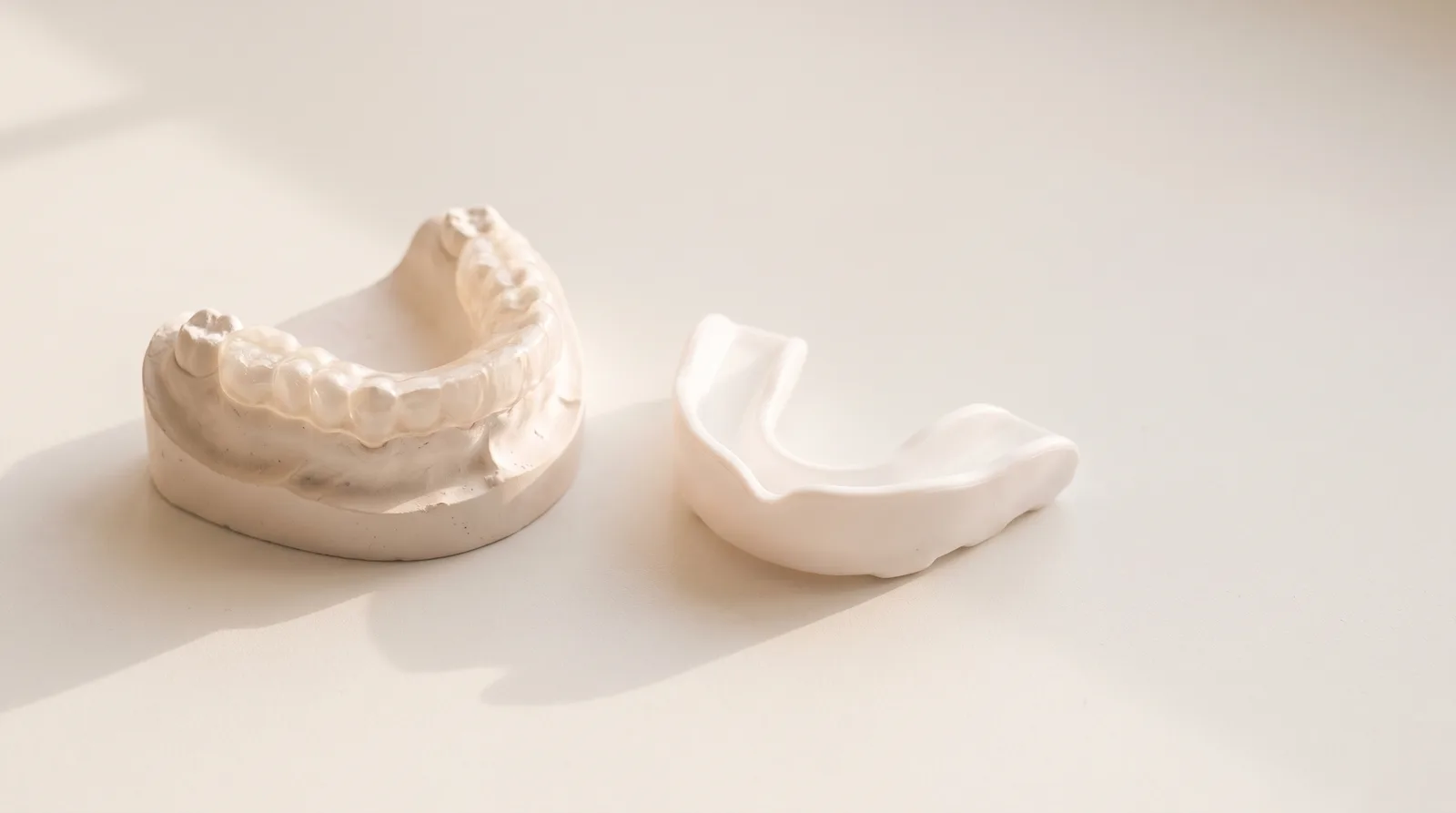
You can pick up a mouthguard in a sports shop, or have a dentist make one to fit your teeth. If you or your child plays a contact sport, it is fair to ask whether the difference matters. UK guidance favours the custom-made kind, but the studies that compare the two types directly are limited.
Who should wear a mouthguard?
The Oral Health Foundation says to wear one for contact sports and for any sport where you could be hit in the mouth. It lists cricket, rugby, hockey, football, martial arts, American football and boxing. Without a mouthguard, it says, you are more likely to break or chip a tooth, have a tooth knocked out, or injure your lips, tongue, cheeks or jaw.
The Faculty of Sport and Exercise Medicine UK says anyone at risk of a mouth or face injury should wear a well-fitting mouthguard in training as well as in matches. Some UK sports require one, boxing among them, according to the British Orthodontic Society, and most organisations recommend one for field hockey and martial arts. Your club or school can tell you what applies.
A 2019 meta-analysis (a pooled analysis of many studies) cited by the Faculty found that people without a mouthguard had 2.33 times the risk of a mouth or face injury. A 2026 review quotes 1.6 to 1.9 times. The size varies, but both point the same way. No mouthguard can be expected to give absolute protection, the British Orthodontic Society cautions.
This guide is about guards for sport. Guards for grinding at night are a separate topic, covered in our guide to teeth grinding.
How do the three types differ?
The Faculty and the British Orthodontic Society describe three types of mouthguard.
| Type | How it is made | What the UK bodies say |
|---|---|---|
| Custom | A laboratory makes it from an impression or scan of your teeth | Highest protection; stays in place well and is comfortable |
| Boil-and-bite | You soften it in hot water, then mould it by biting | Fit and quality can be compromised, as they depend on materials and your technique; not as strong or resilient |
| Stock | Ready-made in set sizes, not moulded to you | Poor fit and the least protection |
The Oral Health Foundation does not recommend shop-bought or home kits. Its concerns are poor fit, discomfort, guards that fall out during play, less protection for teeth and jaws, and that they can be a choking risk.
The Faculty says custom-made guards offer higher protection, but anyone at risk of a mouth or face injury should still wear a well-fitting mouthguard in training and matches. If you cannot get a custom guard yet, ask your dentist what to wear in the meantime.
What does the evidence show?
The guidance is consistent, but the evidence behind it is less complete. More high-quality studies are needed, the Faculty says, to understand fully how much more protection a custom-made guard gives than a boil-and-bite one. Its recommendations rest on cohort studies, private dental insurance data and studies in which people recalled their injuries afterwards.
A 2026 scoping review, which maps the research rather than pooling results, searched five databases and found eight qualifying studies from 1989 to 2025. Custom-made guards were associated with fewer tooth injuries, cuts inside the mouth and jaw-joint injuries, with statistically significant results in several, but mostly in comparison with wearing no guard. The studies were too varied to combine, and several compared guard users with non-users instead of custom-made guards with other types. The authors say that rules out a definitive conclusion that custom-made guards are better.
The studies mostly support a general protective effect from wearing a mouthguard. How much extra a custom-made one adds is less certain, although the Faculty says its comfort and stability are likely to help people keep wearing it.
What makes a mouthguard fit well?
The Faculty gives a simple test. Put the guard in and open your mouth wide: it should stay in place without you holding it. At a minimum, it should stay put with your jaws clenched, while you breathe and with your mouth open.
Give a new guard time. The Faculty suggests wearing it for about a month before competition, so you get used to it and can breathe comfortably in it. The 2026 review notes that people often avoid mouthguards because of discomfort, poor retention and difficulty breathing or speaking, which it says are often due to poor materials and non-custom designs.
What about head injuries?
Sources differ. A mouthguard can also help reduce the impact of a blow to the head, says the Oral Health Foundation. The British Orthodontic Society says that, contrary to earlier evidence, guards do not appear to give extra protection from neurological injury. The 2026 review describes the evidence for concussion as less conclusive than for tooth and mouth injuries.
Most head injuries are not serious, but the NHS says it is important to get medical help for any symptoms. Its head injury and concussion page lists when to call 999 or 111. After a minor head injury, it says not to play contact sports for at least 3 weeks. See a GP if you are not sure it is safe to return to sport.
Caring for a mouthguard and replacing it
Clean it after every use, for example with a toothbrush and toothpaste or soap, as the Faculty suggests, and rinse it in cool water. Keep it in a clean, hard, ventilated case. Heat and sunlight can change its shape or damage the material, according to the Faculty and the Oral Health Foundation.
A guard wears out. An older one can become worn, thin and ill-fitting, the Faculty says, and it should be replaced straight away if you doubt its fit or protection. The British Orthodontic Society adds that a cracking guard, or a changing bite, means a new one. Routine dental visits are a chance to have it checked.
Children and teenagers may need a new mouthguard more often, the Oral Health Foundation says, because growing jaws and new adult teeth change the fit. Adults with all their adult teeth can keep the same one for longer, but it may still need replacing every few years.
Mouthguards and braces
The British Orthodontic Society says anyone with fixed braces who plays contact sports should wear a mouthguard, and that removable appliances should come out first. Special designs exist for fixed braces. Because teeth move during treatment, a guard may stop fitting and need adjusting or replacing. The Society’s advice sheet says the research does not show clearly which type is preferable with fixed braces. It adds that a fitted custom-made guard, with room for planned tooth movement, appears to be the design of choice. For fixed functional appliances such as the Herbst, the sheet says they do not support a mouthguard and advises refraining from contact sport during that phase of treatment. Ask your orthodontist which type suits you.
When to see a dentist
- a tooth has been knocked out, even if you cannot find it: ask for an emergency dentist appointment
If the blow also hit the head, check the NHS head injury advice straight away, because it lists when to call 999 or 111.
For a knocked-out adult tooth, the NHS says to hold it by the crown, the white part, and not touch the root. If it is dirty, rinse it gently in milk, saline or saliva. Try to put it back in the gap, and if it goes back in easily, bite gently on a clean cloth to hold it there. If it will not go back, keep it in milk or in saliva (spit into a container), and get to a dentist as soon as possible. Never put a baby tooth back in, because it could damage the tooth growing underneath.
Out of hours, call your dentist, as the answerphone may say what to do, the NHS advises. If you do not have a dentist or cannot get an emergency appointment, call NHS 111.
- a tooth has been chipped, cracked or broken (keep any piece that came off in milk or saliva and take it with you)
- your mouthguard feels tight or loose, has cracked or has worn thin
- a child has new adult teeth coming through or has grown, so the guard may no longer fit
- you wear fixed braces and your guard no longer fits
For a chipped, cracked or broken tooth, the NHS says to see a dentist, not a GP, because a GP cannot give dental treatment.
What we would do
A sports mouthguard at TG’s Dental Suite is custom-fitted. We take an impression of your teeth, and a dental laboratory makes the guard to that impression. We then check it in the practice and adjust it so it sits securely. It can be made in a colour and thickness to suit your sport. Our sports mouthguards page has the details, and any of our five practices can arrange one.
For children and teenagers, our page says it is worth having a mouthguard checked regularly, because a growing mouth can change shape over a season and a loose guard gives less protection. Bring yours back if it feels loose or your mouth has changed. The British Orthodontic Society’s 2023 advice sheet says mouthguards are not available on the NHS, and our price list shows what a sports mouthguard costs with us.
If a tooth is knocked out or broken, our emergency dentist page explains how to reach your nearest practice. If you play a contact sport and would like a guard made, you can book an appointment at whichever practice suits you.
Want us to take a look?
Book an appointment at whichever of our five practices suits you. We will check what is going on and talk you through your options.
Questions this guide answers
Do shop-bought mouthguards protect teeth at all?
A 2026 review describes a 1989 study in which most guards were stock or boil-and-bite, and guard users had significantly fewer tooth injuries and cuts inside the mouth than non-users. That study cannot show how they compare with custom-made guards. The Oral Health Foundation does not recommend shop-bought kits, citing fit, comfort and less protection.
How long does a custom-made mouthguard take?
The Oral Health Foundation says you usually receive one within about a week of the impression being taken. Ask your dentist how long theirs takes.
How often should I replace a mouthguard?
Children and teenagers may need a new one more often, because growing jaws and new adult teeth change the fit, the Oral Health Foundation says. Adults may need to replace theirs every few years. Replace any guard that cracks, wears thin or no longer fits.
Will a mouthguard protect against concussion?
Sources differ. The Oral Health Foundation says a mouthguard can help reduce the impact of a blow to the head, but the British Orthodontic Society says guards do not appear to give extra protection from neurological injury. A 2026 review calls the concussion evidence less conclusive. The NHS says to get medical help for any head injury symptoms.
Can I wear a mouthguard with braces?
The British Orthodontic Society says people with fixed braces who play contact sports should wear one, and that special designs exist for braces. Teeth move during treatment, so a guard may need adjusting or replacing. Ask your orthodontist which type suits you.
Sources (7)
- Protect Your Smile with Mouthguards
- Mouthguards: advice sheet
- Mouthguards for the prevention of oro-facial trauma in sport
- Custom-Made Versus Non-Custom Mouthguards in the Prevention of Sports-Related Oro-Dento-Facial Trauma: A Scoping Review of the Clinical Evidence
- Knocked-out tooth
- Chipped, broken or cracked tooth
- Head injury and concussion