Professional teeth cleaning explained
A scale and polish removes plaque, tartar and stains. Deep cleaning below the gum treats more serious gum disease. Routine cleans have not been shown to help adults with healthy gums, so ask your dentist.
On this page
You may have been told you need a scale and polish, or a deep clean, and the two can sound like one thing. They are different, and not everyone needs either on a fixed schedule.
What is a scale and polish?
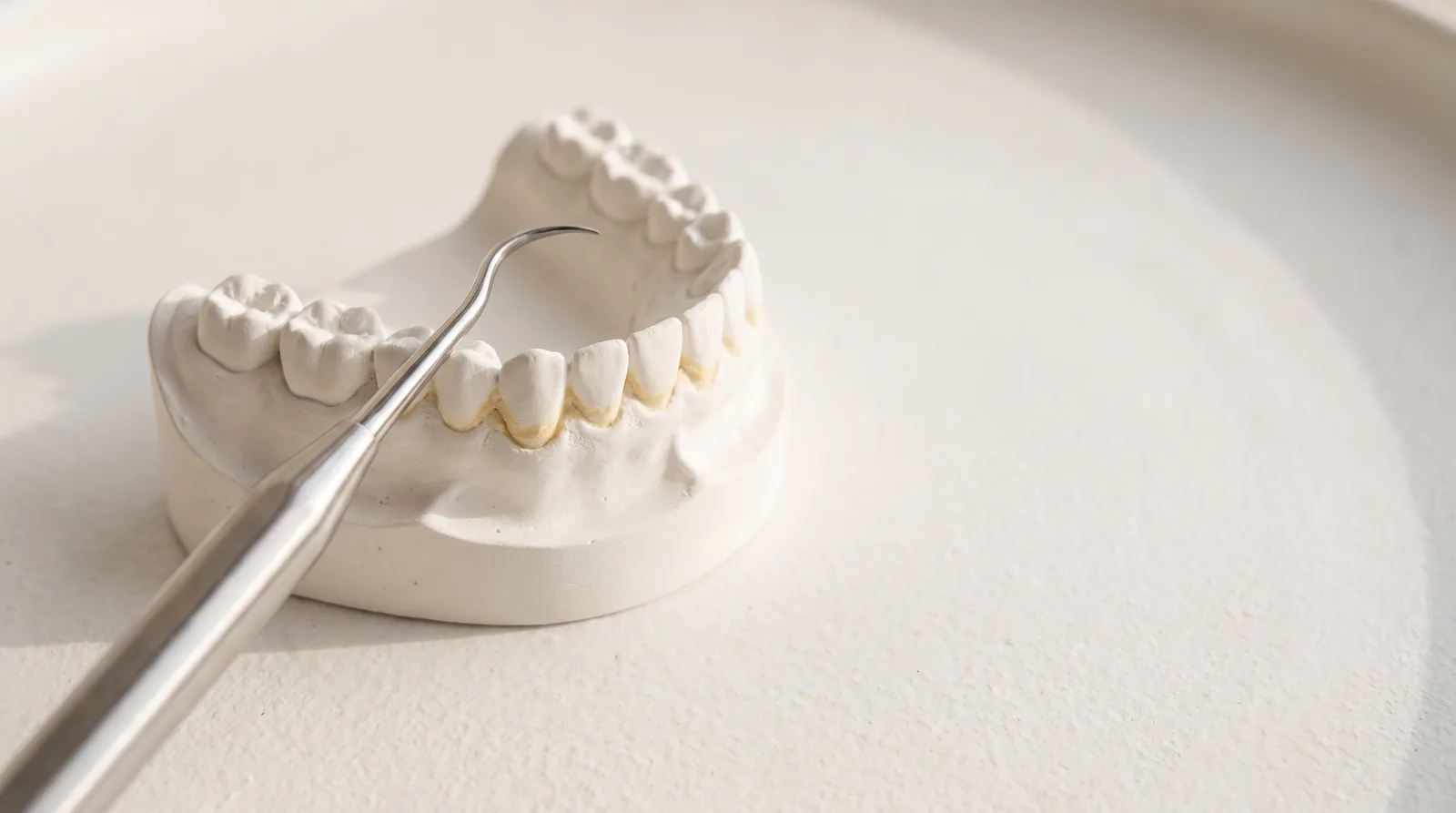
The NHS describes a scale and polish as a clean by the hygienist that carefully removes the plaque and tartar that build up on your teeth. Tartar, also called calculus, is hardened plaque. A 2018 Cochrane review says it is so hard that toothbrushing alone cannot remove it.
The review describes the two parts. Scaling removes plaque, tartar, debris and staining, using hand instruments or ultrasonic scalers. Polishing then removes stain that is left, usually with a paste on a rubber cup or brush. The Scottish dental guidance adds that air polishing removes soft plaque but not tartar, so hand or powered instruments are still needed where tartar is present. The same guidance says hygienists and dental therapists can see you directly, within their scope of practice, or treat you under a plan agreed with a dentist.
What is deep cleaning?
Deep cleaning is the everyday name for cleaning below the gum. The NHS lists deep cleaning under your gums among the treatments you may need if gum disease is serious. Dental teams call it subgingival instrumentation, or subgingival professional mechanical plaque removal. It cleans plaque, tartar and endotoxin, a bacterial toxin, from the root surfaces of the teeth.
| What you may hear | What it removes | Where |
|---|---|---|
| Scale and polish | Plaque, tartar, stain | Tooth crown, mostly above the gum |
| Deep cleaning | Plaque, tartar, endotoxin | Tooth root, below the gum |
Calculus just below the gum that is easy to reach can also be removed during the first stage of care, according to the Scottish guidance. It lists scale and polish, root planing and root surface debridement among the older terms for professional cleaning, so you may still hear any of them.
The British Society of Periodontology and Implant Dentistry (BSP) sets out the order of care for periodontitis in its UK guideline. First comes an explanation, help with cleaning at home and with risk factors such as smoking, and often a first professional clean. The team then re-checks your home cleaning. If it has improved enough, deep cleaning is next, and if not, the first step is repeated. Your gums are checked again about 3 months later. Areas that have not settled may need more cleaning or a referral to a specialist. Once your gums are stable, you move to supportive care, with visits every 3 to 12 months set for you. Our guide to gum disease covers the whole pathway.
Clinical results for periodontitis are the same whether deep cleaning is done in one or two long appointments within 24 hours or across several shorter ones, the Scottish guidance says.
Do you need a professional clean?
The government’s prevention toolkit for dental teams says no clinical benefits of routine scale and polish have been demonstrated for adults with good gum health. It also says professional care plays an important role for people with advanced gum disease.
The toolkit cites a Cochrane review of planned cleans every 6 or 12 months in adults without severe gum disease who attended regularly. It found two trials, with 1,711 people in UK general dental practices, followed for 24 and 36 months.
- Gum inflammation, pocket depth and quality of life differed little or not at all between six-monthly, 12-monthly and no scheduled cleans. The review rates this high-certainty evidence.
- Planned cleans slightly reduced tartar. The review says it is unclear whether that matters to patients or dentists.
- People who had the cleans said their teeth felt cleaner, though the review rates that evidence low-certainty.
The review searched for trials up to January 2018. Both trials it found studied adults without severe gum disease who attended a UK dentist regularly, so they say little about people with severe gum disease.
Professional care can still help. The toolkit says tartar, or a filling edge that sticks out and traps plaque, may need removing if your gums show signs of disease. It may not be needed if there are no signs of gum inflammation (gingivitis). The NHS says that in early gum disease your dentist may advise a clean by a hygienist. A Scottish patient leaflet adds that removing hardened plaque can help you clean better at home.
How often depends on your own gums. The BSP says a Basic Periodontal Examination (BPE) score, a measure of your gum health, should be part of a routine check, and that it is worth asking your dentist what yours means.
What does it feel like, and what happens afterwards?
Comfort varies. The Scottish guidance says some patients feel pain during and after cleaning below the gum, and that local anaesthetic can make treatment more comfortable. The BSP says you can ask for an injection to numb your gums and teeth if you prefer. If you are nervous, tell the team before you start. Our page for nervous patients explains how we help.
After treatment for gum disease, the BSP says:
- your gums are likely to bleed more at first, which is normal and improves, so keep cleaning
- as gums get healthier they may shrink, so spaces can appear between teeth and teeth can look longer
- teeth may feel more sensitive to hot, cold or sweet things, usually settling within a few weeks, though some people need a sensitivity toothpaste or other treatment
After cleaning below the gum for gum disease, around half of patients may notice more sensitivity, especially if their teeth were sensitive before, says the Scottish guidance. The Cochrane review notes that scaling has been linked to tooth surface damage and sensitivity, but its two trials did not measure side effects.
What helps a clean work?
Cleaning at home is part of the treatment, and the NHS says to clean between your teeth every day with floss or interdental brushes. The BSP says regular, effective plaque removal by you offers the largest treatment benefit, and its patient leaflet says gum disease treatment will only work if you clean your teeth properly, twice a day, to a high standard. Our guides to plaque and bleeding gums cover the daily routine.
A Scottish patient leaflet says gums may bleed when you start cleaning them properly, that this comes from inflammation and not damage, and that it should settle after a few weeks. It also says stopping smoking, if you smoke, makes gum disease treatment more successful. Tell your dental team about any health conditions and the medicines you take, because the BSP says some conditions change how gum disease is managed.
When to see a dentist
- you have gum disease and also very sore and swollen gums, teeth becoming loose or falling out, ulcers or red patches in your mouth, or a lump in your mouth or on your lip: the NHS says to ask for an urgent dentist appointment
For an emergency or out of hours, the NHS says to call your dentist first, since their answerphone may tell you what to do. If you have no dentist or cannot get an emergency appointment, it says to call 111.
Periodontitis is not always painful and you might not know you have it, says the Scottish leaflet. The NHS says to see a dentist if you have not had a check-up for 2 years, or 1 year if you are under 18. It advises regular check-ups with a dentist and a hygienist, especially if you are pregnant or have type 2 diabetes.
- your gums bleed when you brush your teeth or eat hard foods
- your gums are painful or swollen
- you have bad breath
- your gums are shrinking
- your child has sore, bleeding gums
Gum disease can lead to a dental abscess, the NHS says. Our guide to tooth infection and abscess covers the signs and what to do.
What we would do
If it has been a while, a new patient exam comes first. We examine your teeth, gums and soft tissues, take small X-rays where needed and explain what we find.
At a dental hygiene appointment, your hygienist checks your gum health and looks for plaque build-up and early signs of gum disease. They then clean and scale your teeth and finish with a polish, and advise you on brushing and flossing. Most appointments take 20 to 30 minutes, and how often you come back is set after your dentist or hygienist has checked your gums.
Our price list shows single, double and triple hygiene and periodontal sessions. EMS Airflow, which uses a fine powder and warm water to remove surface staining, is an add-on to a hygiene visit. Where a gum pocket has not settled with cleaning alone, a perio chip can be placed after a periodontal clean, alongside it and not instead of it.
If you are unsure which of these you need, book an appointment and your dentist or hygienist can check your gums and tell you.
Want us to take a look?
Book an appointment at whichever of our five practices suits you. We will check what is going on and talk you through your options.
Questions this guide answers
Is a scale and polish the same as a deep clean?
Not quite. A scale and polish removes plaque, tartar and stains, mainly from the part of the tooth above the gum. Deep cleaning, which UK guidance calls subgingival instrumentation, cleans the root surfaces below the gum and is part of treating periodontitis, the later stage of gum disease.
Do I need a scale and polish every six months?
The government prevention toolkit says no clinical benefit of routine scale and polish has been shown for adults with healthy gums. A Cochrane review of two UK trials, in adults without severe gum disease who saw a dentist regularly, found little or no difference in gum inflammation between six-monthly, 12-monthly and no scheduled cleans. Your dentist can tell you what suits your gums.
Does deep cleaning hurt?
The Scottish dental guidance says some patients feel pain during and after cleaning below the gum, and that local anaesthetic can make treatment more comfortable. The British Society of Periodontology and Implant Dentistry says you can ask for an injection to numb your gums and teeth if you prefer.
Why are my teeth sensitive after a clean?
After cleaning below the gum for gum disease, the Scottish dental guidance says around half of patients may notice more sensitivity, especially if their teeth were sensitive before. The British Society of Periodontology and Implant Dentistry says it usually settles within a few weeks, though some people need a sensitivity toothpaste or other treatment.
Sources (8)
- Dental treatments
- Gum disease
- Prevention and Treatment of Periodontal Diseases in Primary Care, second edition (updated November 2025)
- Information about periodontitis: what is it and what can you do about it? (patient leaflet, 2024)
- Delivering better oral health: an evidence-based toolkit for prevention, chapter 5: periodontal diseases
- Routine scale and polish for periodontal health in adults
- BSP UK clinical practice guidelines for the treatment of periodontal diseases (flow chart, 2021)
- Periodontal health for a better life (patient information leaflet, 2017)