Implant materials and mini implants
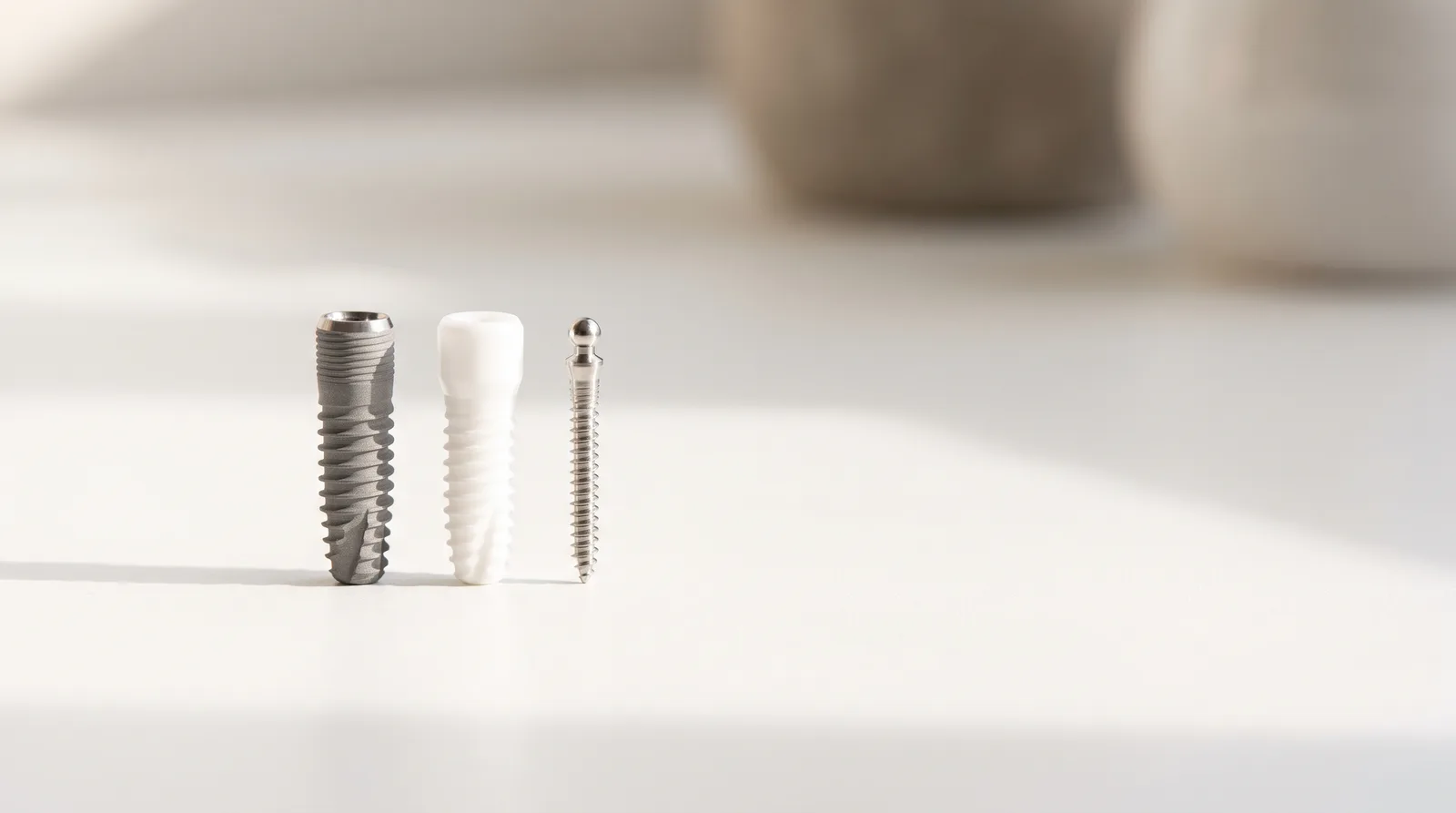
Most dental implants are made of titanium. Zirconia, a white ceramic, is an alternative with fewer and shorter studies. Mini implants are narrower, and the research looks mostly at those holding dentures.
On this page
If you are weighing up a dental implant, you may have read that implants come in different materials, and that there are “mini” versions. Most UK patient guidance simply says titanium and moves on, so it is fair to ask what else exists and what the evidence shows. This guide covers implants that replace a tooth root, using UK sources where they exist and published reviews where they do not.
What are dental implants usually made of?
The NHS describes a dental implant as a titanium screw placed into the jaw bone to support a crown, bridge or denture. A patient leaflet from Leeds Teaching Hospitals NHS Trust says it is usually made of titanium alloy, and the Oral Health Foundation also describes a small titanium screw. A guide for dentists from the Association of Dental Implantology (2012) says implants are commonly commercially pure titanium or a titanium alloy, and only occasionally a ceramic such as zirconium dioxide or aluminium oxide.
The sources differ on which form of titanium is more common. A 2023 systematic review from Queen Mary University of London says most implants are commercially pure (grade 4) titanium, and that the alloy (grade 5) has greater fatigue resistance and strength. The same review notes that titanium can discolour the soft tissue around it and carries a risk of hypersensitivity. It links both to a growing interest in metal-free implants.
What are zirconia implants?
Zirconia is a white ceramic, also called zirconium dioxide. A 2024 review in the British Dental Journal describes ceramic implants made from it as relatively new. It says the earlier ceramic implants, made from aluminium oxide, were too brittle, and many fractured. The Queen Mary review dates zirconia’s use in dentistry to the 1990s and zirconia implants to the early 2000s.
Zirconia implants come in two designs, according to the British Dental Journal review:
- One-piece: the implant and the abutment, the part that carries the crown, are a single block, and the crown is cemented on.
- Two-piece: the abutment is a separate part, usually held in place by a small screw.
The authors say two-piece ceramic implants have less long-term data, with studies running up to ten years. They add that a German implantology guideline advises telling patients there is not yet enough evidence to support unlimited use of them.
| Titanium | Zirconia | |
|---|---|---|
| Material | Metal | Ceramic |
| Colour | Grey | White |
| Studies | Run 10 years or more | Fewer, mostly shorter |
| Metal parts | The implant is metal | The implant is ceramic, though some designs use a metal screw |
The table sums up the sources above. It does not rank the two.
Is zirconia better than titanium?
No source we read says so. The 2023 Queen Mary review looked for controlled trials that compared the two and found only two, with 100 zirconia and 99 titanium implants followed for between 12 and 80 months. At 12 months the difference in survival was not statistically significant. The review noted a trend towards more failures with zirconia, and one study reported more fractures of zirconia implants. It concluded that firm conclusions cannot yet be drawn.
Zirconia may have an advantage in the area that shows when you smile, the review says, but no clear advantage could be inferred. One of the two zirconia brands in the trials is no longer sold, which limits how far the findings carry over. The British Dental Journal review says success rates are comparable, that zirconia does not show better clinical results than titanium, and that titanium tends to bond to bone faster at first.
One of the two trials in the 2023 review was supported by the company that made both the zirconia and the titanium implants used in it, which the review reports. The authors of the Queen Mary and British Dental Journal reviews declare no conflicts of interest.
What about metal allergy?
The British Dental Journal review puts the estimated prevalence of titanium allergy in implant patients at 0.6%, which it describes as quite low. It says the risk of a positive allergic reaction is higher in people who have allergy-type symptoms after placement, or an implant that fails for no clear reason. Its authors describe ceramic implants as an option for patients with a proven titanium allergy. If you have a known metal allergy, tell your dentist before treatment.
What are mini implants?
A mini implant is a narrower implant. The Association of Dental Implantology guide says mini implants are usually under 3 mm across, compared with 3.5 to 4.5 mm for a regular implant. The 2025 and 2024 reviews below use the same cut-off of about 3 mm.
According to the 2025 review, mini implants are usually made in one piece, and the most common attachment is a ball-and-ring (O-ring) fitting. Most of the research looks at mini implants holding a removable overdenture in place. Leeds Teaching Hospitals NHS Trust explains that an overdenture clips onto implants with press-stud type attachments, and that you can take it out at night and to clean the implants.
The review authors give two reasons people consider them:
- Being narrow, they can sometimes be placed where there is less bone, with less need for bone grafting.
- Placement is described as simpler, less invasive and quicker than for wider implants.
It is still surgery, and only an assessment can show whether a mini implant suits you. The same review adds that mini implants are often used where bone is thin or of poorer quality (our guide to jawbone loss covers why bone can thin), which may itself affect how well they survive. The authors also say narrow implants carry a higher risk of fracture.
How well do mini implants perform?
The 2025 systematic review pooled 39 studies, covering 3,787 mini implants that held 1,026 dentures in 1,005 patients. People were followed for 28 months on average, and up to seven years. In all, 202 implants failed, mostly in the first year. By the review’s method, about 91 in 100 mini implants were still in place at 7 years.
- Upper and lower jaw: at 5 years, about 87 in 100 were in place in the upper jaw and about 92 in 100 in the lower. Only 109 of the dentures were in the upper jaw, so most of the evidence is from the lower.
- Two or four implants: for lower-jaw dentures, survival was lower with two mini implants than with four, and the authors recommend four.
- Per person: about 13 in 100 people (133 of 1,005) had at least one mini implant fail during the studies.
- Maintenance: the review found a high rate of cracked dentures and worn attachment parts, and says mini-implant dentures may need frequent maintenance visits.
A 2024 review looked only at randomised trials comparing mini implants with standard-diameter implants for lower dentures. It found five, followed for between one week and 12 months. The two that reported survival gave 89 to 98 in 100 for mini implants and 99 to 100 in 100 for standard ones. The authors call mini implants a feasible alternative for holding lower dentures, and say trials of at least five years are needed.
Both reviews are about dentures. They do not tell us how mini implants perform for a single tooth or a bridge.
When to see a dentist
If you already have an implant, the Oral Health Foundation says plaque building up around it can cause a condition called peri-implantitis. Our guide to looking after dental implants covers how to clean around one. The foundation lists the first three signs below. Leeds Teaching Hospitals NHS Trust adds that dentures held by implants, and the clips that hold them, can wear and need replacing, and the 2025 review also found cracked dentures.
- red, sore or swollen gums around an implant
- bleeding around an implant
- infection, or an implant that feels loose
- a denture held by implants that cracks, or attachments that wear
If you think you have a dental abscess, for example a swollen face or jaw, the NHS says to ask for an urgent dentist appointment or get help from NHS 111. It says to call 999 or go to A&E if you find it hard to breathe, speak or swallow, have a swollen or painful eye, or have a lot of swelling in your mouth.
What we would do
A consultation comes first. At our practices we assess your bone density and gum health and talk through whether an implant, a bridge or a denture suits you. Where more detail is needed for planning, we can use X-rays and 3D scans.
The implant described on our dental implants page is a titanium post. Our site does not list zirconia implants, mini implants or dentures that clip onto implants, so please do not read this guide as saying we offer them. Tell us at your consultation if you have a metal allergy or have read about either option, and we will explain what we can and cannot provide. Please also tell us about your medical history and any medicines you take. Leeds Teaching Hospitals NHS Trust says some conditions and medicines, such as poorly controlled diabetes or bisphosphonates, make late loss of an implant more likely. Our guide to dental implants and what to know first covers the treatment itself.
If you are comparing options, our guide to replacing a missing tooth sets out the choices, and you can book a consultation and ask what your implant is made of, and how long that type has been studied.
Want us to take a look?
Book an appointment at whichever of our five practices suits you. We will check what is going on and talk you through your options.
Questions this guide answers
What are most dental implants made of?
The NHS describes an implant as a titanium screw placed into the jaw bone. A Leeds Teaching Hospitals leaflet says it is usually a titanium alloy, and a 2023 review says most are commercially pure titanium. Either way, titanium is the usual material.
Are zirconia implants better than titanium ones?
No source we read says so. A 2023 review found only two controlled trials comparing them and said firm conclusions could not yet be drawn. A 2024 British Dental Journal review says zirconia does not show better clinical results than titanium. Zirconia is white, and the implant itself contains no metal, which is why some people ask about it. Some two-piece designs still use a metal screw.
Is titanium allergy common?
A 2024 British Dental Journal review gives an estimated prevalence of titanium allergy in implant patients of 0.6%, which it describes as quite low. Tell your dentist about any known metal allergy before treatment.
What is a mini implant?
A narrower implant, usually under about 3 mm wide. The reviews we read look mainly at mini implants holding removable dentures in place, most often in the lower jaw. They still involve surgery, and an assessment decides whether they suit you.
Do mini implants last as long as standard implants?
No source we read gives a lifespan for them. A 2025 review estimated that about 91 in 100 would still be in place at 7 years, though on average people in it were followed for just over two years. Failures were more common in the upper jaw. Two short trials that reported survival gave 89 to 98 in 100 for mini implants and 99 to 100 in 100 for standard ones.
Sources (9)
- Dental treatments
- Dental implants: information for patients
- Understanding dental implants
- A dentist’s guide to implantology
- Survival and success of zirconia compared with titanium implants: a systematic review and meta-analysis
- One-piece versus two-piece ceramic dental implants
- Clinical and radiographic outcomes of mini-implant-retained maxillary and mandibular overdentures: a systematic review and meta-analysis
- Retention of mandibular complete overdentures using mini dental implants and standard diameter implants: a systematic review and meta-analysis of randomised controlled trials
- Dental abscess