Jawbone loss after losing a tooth
The ridge of bone that held a tooth shrinks once it is out, mostly in the first months. A graft in the socket may reduce this, but the evidence is very uncertain. Gum disease can also damage bone around your teeth.
On this page
If you have lost a tooth, or been told one has to come out, you may have heard that the jawbone shrinks afterwards. Studies show that it does, and it can change which replacement options suit you.
What happens to the jawbone after extraction?
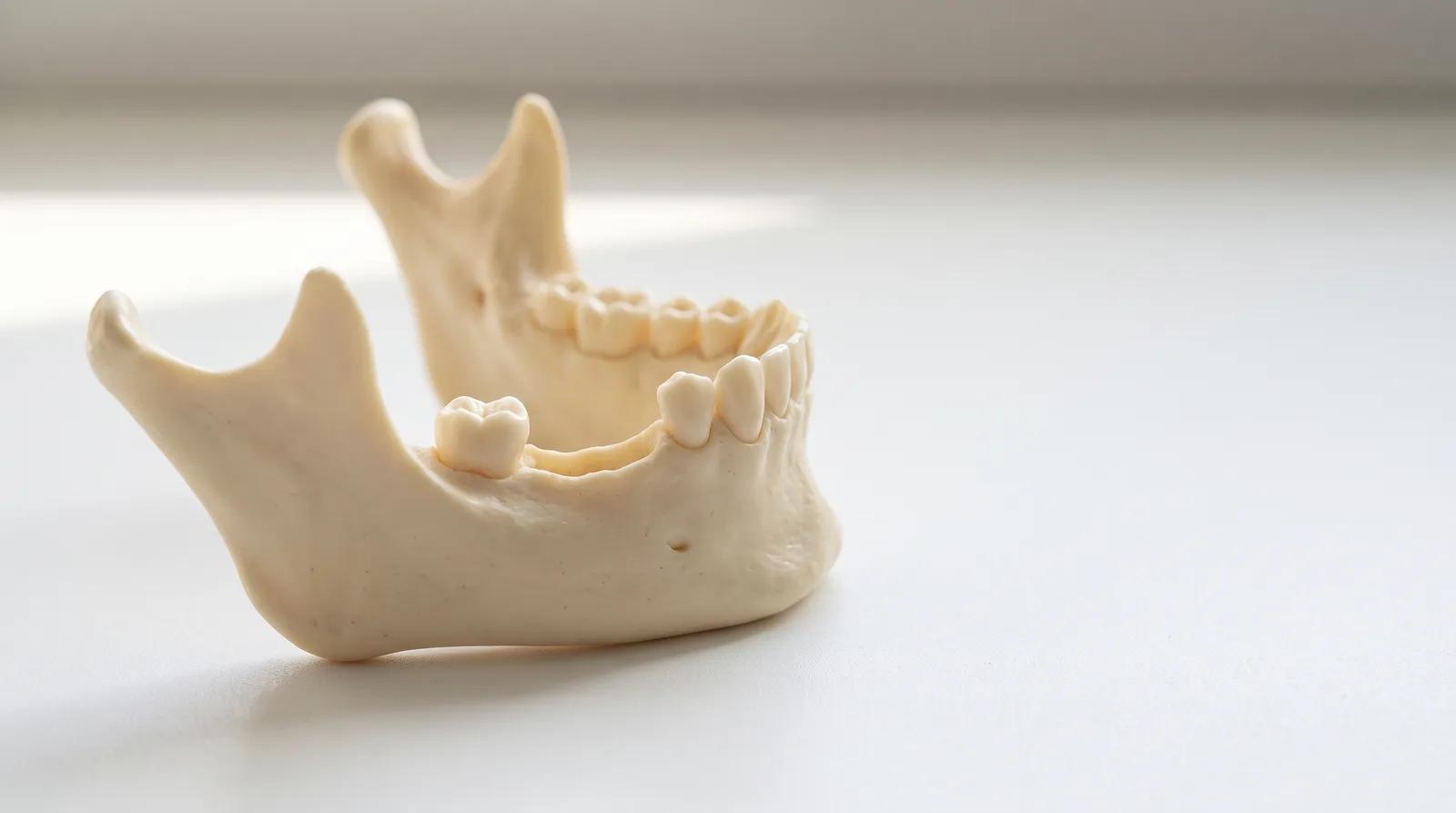
Your teeth sit in sockets in a ridge of bone along each jaw. Once a tooth is taken out, the socket heals and the ridge changes shape: it becomes narrower and lower.
A 2012 systematic review looked at 20 studies that tracked these changes for up to 12 months after extraction. In the studies that measured the bone directly, in sockets left to heal on their own, the ridge had lost the following by about six months.
| At about six months | Lost across studies |
|---|---|
| Width of the ridge | 29 to 63 percent |
| Height of the ridge | 11 to 22 percent |
The same review found the loss was quickest in the first 3 to 6 months and slower after that. These are ranges across studies, not a forecast for your own jaw.
A 2021 Cochrane review, written about preparing the site for an implant, starts from the same point: bone changes after an extraction can get in the way of replacing the missing tooth.
How does it affect the ways to replace a tooth?
How much bone you have affects which options are possible.
Implants need enough bone where they go, according to both the Leeds Teaching Hospitals and Cambridge University Hospitals leaflets. Leeds says assessment usually includes a 3D X-ray that also checks how much bone there is.
If there is not enough, grafting may be possible. Leeds says that where only a little bone is missing, grafting can be done when the implant is placed, using bone chips from nearby, sometimes mixed with bone substitute, under a protective membrane. More bone means grafting several months earlier, and in the upper jaw a sinus graft can add height. Cambridge puts extensive grafting at least four months before the implant, and says the graft acts as a scaffold for your own bone, which can take four to twelve months to grow in.
Grafting has risks. Cambridge lists infection, the graft becoming exposed, and not enough of your own bone forming, and says the risk of the graft failing is higher in some people, especially smokers. It says minor problems are expected in around 30 in 100 cases, and that rare but serious ones include long-term numbness or tingling in the lower jaw, cheek, chin, lip or tongue, and a hole between the sinus and mouth that needs further surgery. Leeds adds that grafting makes implant treatment more complex and longer.
There are two other options:
- Dentures. The NHS says gums and jawbone may shrink or change shape as you get older, so dentures can become loose. Immediate dentures, which can be made within a few days, often need adjusting or replacing up to a year later, because the mouth can change shape as it heals after teeth are removed.
- A bridge, or leaving the gap. Cambridge describes bridges fixed onto neighbouring teeth, and both leaflets say that in some cases it can be better to accept the space.
Can jawbone loss be prevented?
Two approaches have been studied, and neither is proven to prevent it.
A graft in the socket when the tooth comes out
Ridge preservation means placing graft material in the socket at the time of extraction, to limit the changes described above. The 2021 Cochrane review looked at 16 randomised trials, covering 524 extraction sites in 426 adults. It found that these techniques may reduce the changes in ridge height and width six months after extraction, but it rates the evidence as very uncertain.
It found no evidence of a difference in whether extra grafting was needed later for an implant, or in implant failure, but says information and long-term data are lacking. Complications reported in the trials included delayed healing, pain and swelling, and loss of some graft material. The authors call for longer trials.
Dental implants
A dental implant is fixed into the jawbone, which raises the question of whether it keeps the bone from shrinking. A 2023 systematic review looked at this. Six of its 14 studies, covering 453 people, measured bone loss in the ridge. Its meta-analyses for the lower back jaw and the upper front jaw found no benefit from implant-supported teeth compared with conventional ones.
The authors said the evidence was not enough to confirm that implants preserve the tissues of the mouth and face, although the thickness of a chewing muscle, the masseter, did favour implants. So, on current evidence, we cannot say that implants prevent bone loss.
Bone around an implant can also be lost. The government toolkit describes peri-implantitis as plaque-related inflammation around an implant with progressive loss of supporting bone, and says poor oral hygiene, a history of periodontitis (advanced gum disease), smoking, diabetes and missing regular maintenance care appear to be risk factors. Our guides to dental implants and looking after dental implants cover this in more detail.
Gum disease and the bone around your teeth
Jawbone can also be lost while teeth are still there. The government’s prevention toolkit explains that early gum disease, gingivitis, stays in the gums and can be reversed by reducing plaque. Periodontitis, the later stage, causes progressive destruction of the tissues that support the teeth, including the bone, and the toolkit calls that bone loss largely irreversible. The NHS says gum disease can lead to shrinking gums and to teeth becoming loose or falling out.
That is why the toolkit stresses self-care. The NHS advice for preventing gum disease is to brush at least twice a day with fluoride toothpaste, clean between your teeth every day, not smoke, and have regular check-ups with a dentist and hygienist. If gum disease is found early, the NHS says your dentist will give advice on keeping your teeth clean, advise a clean by a hygienist, and advise stopping smoking if you smoke. Our guides to gum disease and smoking and your mouth go further.
When to see a dentist
The NHS says to see a dentist if your gums bleed when you brush or eat hard foods, your gums are painful and swollen, or you have bad breath. It says to ask for an urgent dentist appointment if you have gum disease and other symptoms such as:
- very sore and swollen gums
- teeth becoming loose or falling out
- ulcers or red patches in your mouth
- a lump in your mouth or on your lip
For urgent care, the NHS says to call your dentist first, and to call 111 if you do not have a dentist or cannot get an emergency appointment.
If you wear dentures, the NHS says to see a dentist if they click when you talk, slip, no longer fit properly or cause pain.
Before an extraction or an implant, tell your dentist about any medicines you take. Leeds lists certain medicines, such as bisphosphonates, among the things that make late implant failure more likely. Do not stop any medicine without asking the doctor who prescribed it.
What we would do
We would begin with a new patient exam. We look at your teeth, gums and mouth, take small X-rays where needed, and explain any options in plain language. When more detail is needed, our X-rays and scans page describes a panoral X-ray of the whole jaw and a 3D scan that shows the jaw and surrounding bone. If a tooth has to come out, our tooth extraction page says we take an X-ray to see the roots and the bone around them, and talk through a bridge, denture or implant if you want one.
Our dental implants page says you need enough bone and healthy gums, and that our dentists assess your teeth and jaw at consultation. Our implant cost guide explains that where there is not enough bone, grafting comes first and is priced separately. We also offer dental bridges and dentures. A graft placed in the socket at the time of extraction is not one of the treatments listed on our site, so ask your dentist what is possible in your case.
If you are weighing up what to do after losing a tooth, book an appointment and we can look at your teeth, gums and bone together.
Want us to take a look?
Book an appointment at whichever of our five practices suits you. We will check what is going on and talk you through your options.
Questions this guide answers
How fast does the jawbone shrink after a tooth is taken out?
A 2012 systematic review found the ridge changed fastest in the first 3 to 6 months and more slowly after that. By six months, studies that measured the bone directly found it had lost 29 to 63 percent of its width and 11 to 22 percent of its height. Those are ranges across studies, not a forecast for your own jaw.
Do dental implants stop jawbone loss?
The evidence does not show that. A 2023 systematic review found no benefit for implant-supported teeth over conventional ones in its meta-analyses of ridge bone loss. The authors said the evidence is not enough to confirm that implants preserve the tissues of the mouth and face. Your dentist can explain what an implant can and cannot do in your case.
Can bone be rebuilt if there is not enough for an implant?
Sometimes. NHS hospital leaflets from Leeds and Cambridge describe grafting to build up bone. It can be done at the same visit when only a little bone is needed, or months beforehand when more is needed (Cambridge says at least four months). It adds time and complexity and carries risks, so your dentist has to assess whether it suits you.
Can gum disease cause bone loss around my teeth?
Yes. The government prevention toolkit says periodontitis, the later stage of gum disease, causes progressive destruction of the tissues that support the teeth, including bone, and that the bone loss is largely irreversible. Early gum disease stays in the gums and can be reversed by reducing plaque.
Why do dentures become loose over time?
The NHS says dentures may loosen as the gums and jawbone shrink or change shape with age. It also says immediate dentures, which can be made within a few days, often need adjusting or replacing up to a year later, because the mouth can change shape as it heals. See your dentist if dentures slip or no longer fit.
Sources (8)
- Dentures (false teeth)
- Gum disease
- Delivering better oral health: an evidence-based toolkit for prevention, chapter 5: periodontal diseases
- Dental implants: information for patients
- Bone grafting for dental implants
- A systematic review of post-extractional alveolar hard and soft tissue dimensional changes in humans
- Interventions for replacing missing teeth: alveolar ridge preservation techniques for dental implant site development
- Effect of dental implant therapy on the preservation of orofacial tissues: a systematic review and meta-analysis