Cracked teeth: types, signs and treatment
A cracked tooth can be a surface line or a deeper crack that reaches the nerve, so see a dentist if you suspect one. A swollen face needs an urgent dental appointment. Trouble breathing or swallowing needs 999 or A&E.
On this page
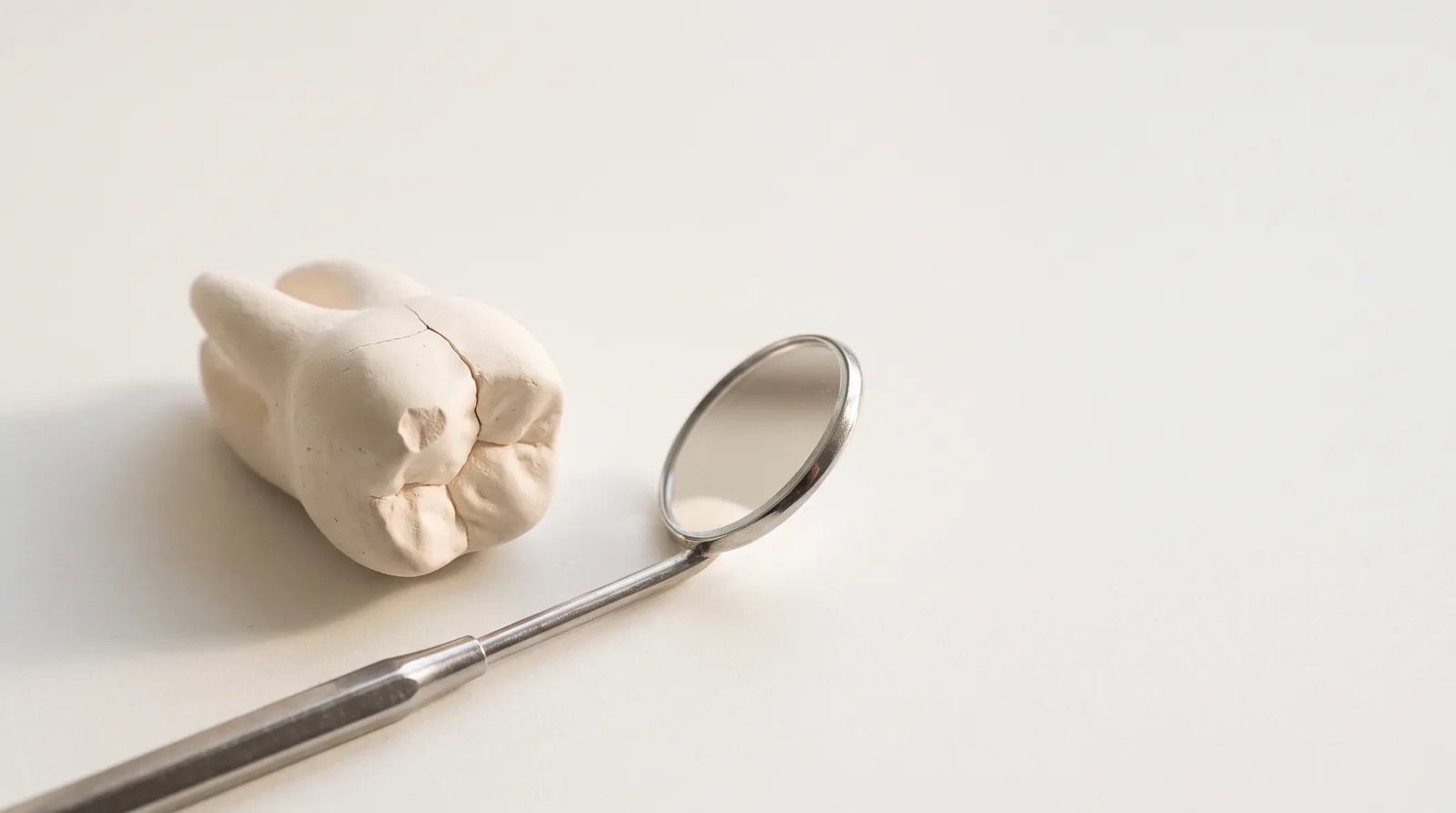
A cracked tooth can be a hairline in the enamel that usually causes no trouble, or a deeper crack that hurts when you bite. From the outside the two can look alike, and a dentist has to look closely to tell them apart. If your face is swollen, or you find it hard to breathe or swallow, go straight to when to get urgent help.
What types of cracked tooth are there?
A 2025 consensus statement from the European Society of Endodontology (ESE), whose field is treating the inside of the tooth, sorts cracks by where they run and how deep they go.
| Type | What it is | What it can mean |
|---|---|---|
| Craze line | A fine line in the enamel only | Common, usually no symptoms, and no treatment unless a stained line bothers you |
| Cracked tooth | A crack into the dentine, the layer under the enamel, of unknown depth. It may run into the root | The nerve may be involved |
| Cracked cusp | A crack through one of the pointed biting parts (cusps) of a back tooth | The piece can break off. Pain may ease once it has |
| Split tooth | The tooth has separated into two parts | The ESE describes the outlook as unfavourable and says removal should be considered promptly |
| Vertical root fracture | A crack running down the root | Can develop quietly and may cause no symptoms early on. More often linked with teeth that have had root canal treatment |
Why do teeth crack?
The ESE says the cause is usually several factors together. One way to sort them is into three groups.
- A sudden force. Biting down on something hard, such as ice, fruit stones, bones or hard sweets, or a knock to the jaw, according to the Oral Health Foundation (OHF).
- Repeated strain. Grinding or clenching your teeth, a bite that does not meet evenly, and a diet of hard foods. Our guide to teeth grinding covers the habit.
- A tooth that is already weaker. Earlier dental work, changes in the dentine with age, and the shape and position of the tooth can all play a part, the ESE says. The OHF adds that large fillings can weaken a tooth.
The ESE reports that back teeth crack more often, and that cracks are most common in people over 40.
What are the signs of a cracked tooth?
Signs depend on where the crack is and how deep. Some cracks cause no symptoms. In a 2018 US study of 2,858 teeth, which the ESE describes, 45% of the cracked teeth had symptoms. Early cracks can be hard to diagnose, because the pain is poorly localised and can be mistaken for other problems.
- pain when you bite, or a short, sharp pain when you let go of the bite
- sensitivity to hot or cold (dental guidance from the Scottish Dental Clinical Effectiveness Programme, SDCEP, also lists sweet food)
- pain that comes and goes
- a missing piece or a hole in the tooth, or a sharp edge that catches your tongue, lip or cheek
The OHF says cracks often do not show on standard X-rays, because the crack has to line up with the beam. The ESE reports a 2017 study in which only 2% of cracked teeth with a living pulp, the soft tissue inside the tooth, showed a crack on an X-ray. An X-ray can show bone loss around the root if a crack has been there some time, the OHF says. Dentists may also use a bright light, a special dye, magnification, or a bite test that reproduces your pain.
Can a cracked tooth be fixed?
A cracked tooth cannot heal itself the way a broken bone does, the OHF says. What a dentist offers depends on how deep the crack is and whether it has reached the nerve or the root. Between them, the NHS and the OHF list these options:
- smoothing and polishing, for a very small crack
- gluing a broken piece back on, if you have kept it
- tooth-coloured resin, used to seal a crack and restore the tooth’s shape
- a filling, or a crown, which is a cap covering the whole tooth. The OHF says larger cracks often need one
- root canal treatment, if the nerve is affected or exposed. Our guide to root canal treatment explains it
- removal of the tooth, in some cases where the crack runs deep into the root
If a crack is shallow and the nerve is healthy, your dentist may suggest checking it over time instead of treating it straight away, the ESE says. It is unclear how long an untreated crack stays stable, because studies have followed cracks for only 1 to 3 years. Left untreated, a crack may lead to lasting nerve damage and possibly loss of the tooth. Teeth at higher risk, such as an extensively filled tooth or a lone, last-standing tooth, call for active treatment.
There is no clear evidence on the most suitable restoration. Teeth repaired with bonded fillings may be more likely to need root canal treatment or a further repair than teeth with a restoration that covers the cusps. Early management is linked with better survival of the tooth, the ESE adds, and where grinding or clenching is involved, managing the habit is part of care.
When to see a dentist
When to call 999 or go to A&E
A crack that has let infection in can lead to a dental abscess, a build-up of pus. The NHS says an abscess needs urgent treatment from a dentist and will not go away on its own. Its dental abscess page says to call 999 or go to A&E if you:
- find it hard to breathe, speak or swallow
- have a swollen or painful eye, or suddenly start having problems with your eyesight
- have a lot of swelling in your mouth
- find it hard to open your mouth
Do not drive yourself: ask someone to take you, or call 999 for an ambulance. Bring any medicines you take. If you think you have breathed in a piece of tooth or filling, the SDCEP says to get emergency medical care straight away. If a fall or accident also hit your head or face, the SDCEP lists the signs that need emergency medical care: a head injury or loss of consciousness, significant facial trauma, or bleeding that is severe and will not stop within 15 to 30 minutes. Go to the nearest emergency department, or call 999 if the person is not safe to move.
Ask for an urgent dental appointment
Ask for an urgent dental appointment if:
- your face or jaw is swollen, or you think you have an abscess
- painkillers do not ease the pain, which the SDCEP says calls for urgent dental care
- a tooth has been knocked out, even if you cannot find it, or is badly broken. The NHS says a knocked-out or badly broken adult tooth needs treating as soon as possible, within 30 minutes to 1 hour if possible
- an adult tooth has broken in a fall, knock or accident. The SDCEP advises urgent dental care whether or not the break reaches the pulp
Call your dentist first, and listen to the answerphone if they are closed. If you do not have a dentist or cannot get an emergency appointment, the NHS says to call 111. Do not go to a GP, who cannot give dental treatment.
While you wait
Keep any broken piece in milk or saliva and take it with you, as the NHS advises. For an open hole, the SDCEP advises dentists that a temporary repair kit from a pharmacy can cover it. Ask a pharmacist about painkillers: the NHS says children under 16 should not take aspirin, and more than the recommended dose can be very dangerous.
For a knocked-out adult tooth, hold it by the crown, not the root, and rinse a dirty one gently in milk, saline or saliva. The NHS says to try to put it back in the socket and, if it goes in easily, bite down gently on a clean cloth to hold it there. If it will not go, keep it in milk or saliva. Never put a baby tooth back.
Other signs worth a prompt visit
The NHS says a chipped, broken or cracked tooth is usually not serious and a dentist should be able to treat it. Arrange a prompt visit if:
- a tooth hurts when you bite, or when you let go of a bite
- a tooth is sensitive to hot, cold or sweet things, or has an ache that comes and goes
- you can see or feel a crack, a chip, a rough edge or a missing piece
- part of a tooth has come off, even if it does not hurt
What we would do
If you have pain or a broken tooth, call your nearest practice and describe what has happened. The team will tell you the soonest appointment they can offer, and each practice’s details are on our Areas We Serve page. At an emergency dentist appointment we identify the cause, take an X-ray if needed, explain your options, and treat the immediate problem with pain relief, a temporary filling or a repair.
For a crack that is not an emergency, a new patient exam looks at your teeth, gums and soft tissues, with small X-rays where needed, and sets out a plan. Depending on what your dentist finds, that could include a filling, a crown (some can be made in one visit with CEREC), root canal treatment where the tooth can still be saved, or a tooth extraction where it cannot.
If a tooth hurts when you bite or has changed, book an appointment and your dentist can look at it. Our guide to toothache covers other causes of tooth pain.
Want us to take a look?
Book an appointment at whichever of our five practices suits you. We will check what is going on and talk you through your options.
Questions this guide answers
Can a cracked tooth heal on its own?
No. The Oral Health Foundation says a cracked tooth cannot heal itself the way a broken bone does. The NHS says a dentist should be able to treat a chipped, broken or cracked tooth. For a shallow crack with no symptoms, a 2025 European Society of Endodontology statement says a dentist may review it over time instead of treating it straight away.
Does a cracked tooth always hurt?
No. Craze lines usually cause no symptoms, and the European Society of Endodontology says an early crack can be something a dentist finds by chance. In a 2018 US study of 2,858 teeth, which its statement describes, 45% of the cracked teeth had symptoms. Pain with cold was the most common, then pain on biting.
Will a cracked tooth show up on an X-ray?
Often not. The Oral Health Foundation says the crack has to line up with the X-ray beam to be seen. A 2017 study described by the European Society of Endodontology found a crack on an X-ray in only 2% of cracked teeth with a living pulp, the soft tissue inside the tooth. Dentists use other checks as well.
What should I do with a broken piece of tooth?
The NHS says to put it in milk or saliva (spit into a container) and take it to a dentist, who may be able to glue it back on. It also says not to go to a GP, because a GP cannot give dental treatment.
Should I wait to see if a cracked tooth settles?
The NHS says to see a dentist if you have chipped, cracked or broken a tooth. The European Society of Endodontology says it is not known how long an untreated crack stays stable, because studies have followed them for only 1 to 3 years. Facial swelling needs an urgent dental appointment. Call 999 or go to A&E if you find it hard to breathe, speak or swallow.
Sources (8)
- Chipped, broken or cracked tooth
- Dental treatments
- Knocked-out tooth
- Dental abscess
- Injuries to the mouth, face and jaws (Management of acute dental problems, 2nd edition)
- Cracked, fractured, loose or displaced tooth fragments and restorations (Management of acute dental problems, 2nd edition)
- Position statement on longitudinal cracks and fractures of teeth
- Cracked teeth