Your child’s first dental visit
The NHS advises taking your child when their first milk teeth appear, or before they are 12 months old. The first visit is usually short and gentle, and it is fine if they will not open wide yet.
On this page
Many parents are unsure when a child should first see a dentist, and what a dentist can usefully do with a baby who has a few teeth and no plans to open wide. The NHS advice is to go early, and a first visit is mostly about advice for you and helping your child get used to the place.
When should a child first see a dentist?
The NHS advises taking your child to the dentist when their first baby (milk) teeth appear, or before they are 12 months old. The aim is for them to become familiar with the surroundings and get to know the dentist, who can advise you on preventing decay and spot any problems early. The Oral Health Foundation gives the same timing: when the first teeth come through, or by the first birthday at the latest.
Baby teeth usually start to come through at around 6 months, though it can be earlier or later, according to the NHS. They are worth looking after: the Oral Health Foundation says they help a child chew and develop speech, and hold space for the adult teeth to come through in the right position.
If your child is older and has not been yet, the NHS says to see a dentist if an under-18 has not had a check-up for a year.
What happens at a first visit?
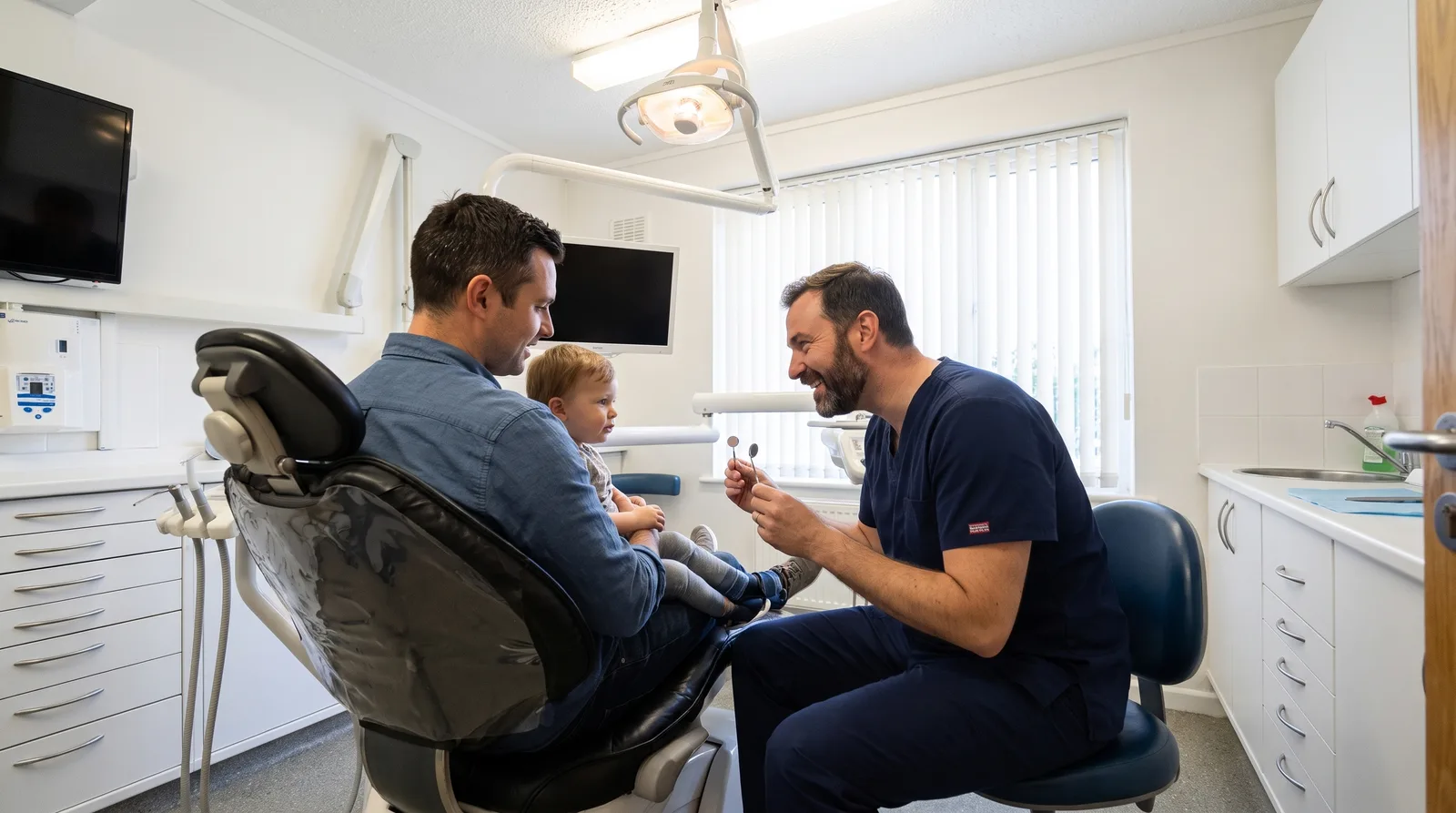
A first visit for a baby is usually short and gentle, and mostly about advice and reassurance, according to the Oral Health Foundation. The dentist often asks about your child’s feeding and brushing routine, gives advice on brushing and diet, and takes a quick look at the mouth. To do that, you may be asked to sit your baby on your knee and gently support their head, which helps your baby feel safe and gives the dentist a clear view.
It is also your chance to ask questions. The usual topics, as the Oral Health Foundation lists them, are how to clean your baby’s teeth, which toothpaste to use, healthy food and drink for growing teeth, and when to come back. Our guide to your oral health and your child’s has toothpaste amounts by age, and our guide to fluoride and your teeth explains toothpaste strengths.
After the first visit, your dentist will tell you how often to bring your child back, and the NHS says to keep taking them for regular check-ups as the dentist advises. If a dummy or thumb habit is on your mind, our guide to dummies and thumb sucking looks at what the sources say.
What if my child will not open their mouth?
This is completely normal and nothing to worry about, says the Oral Health Foundation. Many babies need a few visits to feel comfortable, and simply coming to the practice helps your child get used to it. You can book another check-up in a few months, because the aim is to build confidence, not to force an examination. The NHS makes a similar point: just opening a child’s mouth for the dentist to look is useful practice for the future.
Guidance for dentists from the Scottish Dental Clinical Effectiveness Programme (SDCEP) goes further. If a child becomes distressed, it says, treatment should stop, and a dentist should not force treatment on a child who is unwilling or unable to cope with it.
How can you prepare your child?
You do not need a script. The points below come from NHS and SDCEP guidance.
- Be positive and make the trip fun, the NHS advises. This helps stop your child worrying about future visits.
- Take your child along to your own appointments, so the practice becomes a familiar place.
- Start brushing as soon as the first tooth appears. The NHS says not to worry if you manage very little at first, and suggests making it a game or brushing your own teeth at the same time.
- Ask the practice how to prepare when you book. SDCEP says the dental team should make sure parents know how to support their child.
Your own feelings count too. SDCEP says that when parents cannot hide their own anxiety, it can increase a child’s. If your own fear of the dentist is strong, say so. For very anxious parents, the guidance suggests discussing whether another adult your child knows well could bring them instead.
What if your child is nervous?
Dental anxiety is common, and most obvious in children under four, according to SDCEP. Its guidance for dentists describes several ways to help a child settle, and it is open that the evidence for how well they work is limited. Three you may meet:
- Tell, show, do: the dentist explains in simple words what will happen, shows the instrument, then does it. SDCEP says to use age-appropriate language that avoids technical and emotive terms.
- A stop signal: for school-age and older children, the dentist agrees a signal such as raising a hand, and stops when the child gives it. SDCEP says younger children may not grasp the idea.
- Breathing: for school-age and older children, SDCEP says telling a child to relax does not help, but showing them how to breathe slowly into the tummy can. They rest a hand on their stomach and let the air fill it.
If a child stays very anxious despite these approaches, SDCEP says the dentist should consider referral to a specialist. It also says even very anxious children can be helped to accept preventive care.
Is dental care free for children?
NHS dental treatment is free for children under 18, or under 19 and in full-time education, the NHS says. It adds that not all dentists take on new NHS patients, and points parents to its service search or the local clinic. We are a private practice and are not accepting NHS patients, so that free care applies at NHS dentists, not at ours.
When to see a dentist
A swollen face or jaw, intense pain or a high temperature can be signs of a dental abscess, a build-up of pus caused by infection. The NHS says it needs urgent treatment by a dentist and will not go away on its own. Ask for an urgent dentist appointment or get help from NHS 111, and do not go to a GP surgery, because a GP cannot give dental treatment. For pain while you wait, ask a pharmacist about a painkiller suitable for your child’s age. The NHS says children under 16 should not take aspirin. Our guide to tooth infection and abscess has more.
If your child has signs of a dental infection, such as a swollen face or jaw, the NHS says to call 999 or go to A&E if they:
- find it hard to breathe, speak or swallow
- have a swollen or painful eye, or their eyesight suddenly changes
- have a lot of swelling in their mouth
- find it hard to open their mouth
If a baby tooth is knocked out, do not try to put it back in, because the NHS says this could damage the tooth growing underneath. Ask for an emergency dentist appointment, even if you cannot find the tooth, or call 111 if you cannot get one.
For anything less urgent, the NHS says to see a dentist as soon as possible if you think your child has tooth decay, and that decay may cause no symptoms at first.
- a first tooth has come through, or a first birthday is near, and there has been no visit yet
- white, brown or black spots on a tooth
- toothache, or a sharp pain when eating or drinking something hot, cold or sweet (see our guide to toothache causes)
- gums that are painful, swollen or bleed when brushing
- no check-up in the last year
What we would do
Our children’s dentistry page says we look after children from their first visit, keeping appointments short and unhurried and paced to how your child is feeling. The first visit is a gentle look at your child’s teeth, so the dentist becomes a familiar, routine part of life.
After that, our children’s membership plans cover two dental examinations a year and general dentistry, including scale and polish, and fillings and extractions where the dentist judges them necessary. Dentally fit children under 6 are seen free where a sibling, parent or guardian holds a membership plan at the practice. You can read the plans on our membership and pricing page. Our nervous patients page adds that you can ask us to pause or stop at any point during an appointment.
To arrange a first visit, book an appointment at whichever of our five practices suits you, and mention your child’s age and anything they are worried about.
Want us to take a look?
Book an appointment at whichever of our five practices suits you. We will check what is going on and talk you through your options.
Questions this guide answers
When should my child first see a dentist?
The NHS advises taking your child when their first milk teeth appear, or before they are 12 months old, so they get used to the surroundings and get to know the dentist. The dentist can also advise you on preventing decay.
What if my child will not open their mouth at the first visit?
The Oral Health Foundation says this is completely normal. Many babies need a few visits to feel comfortable, and you can book another check-up in a few months. The aim is to build confidence, not to force an examination.
How can I help my child feel calm about the dentist?
The NHS advises being positive about the visit, making the trip fun and taking your child along to your own appointments. If you are very nervous of the dentist yourself, it is worth telling the practice. SDCEP guidance for dentists says that when parents cannot hide their own anxiety, it can increase a child’s.
Is dental care free for children?
The NHS says NHS dental treatment is free for children under 18, or under 19 and in full-time education, but not all dentists take on new NHS patients. TG’s Dental Suite is a private practice and is not accepting NHS patients.