Your smile and how you feel about it
In UK experiments, people rated photos of altered teeth differently, but that is not a real-life outcome. In a 2021 survey, 12% of English adults reported a severe effect on smiling. A dentist can talk it through.
On this page
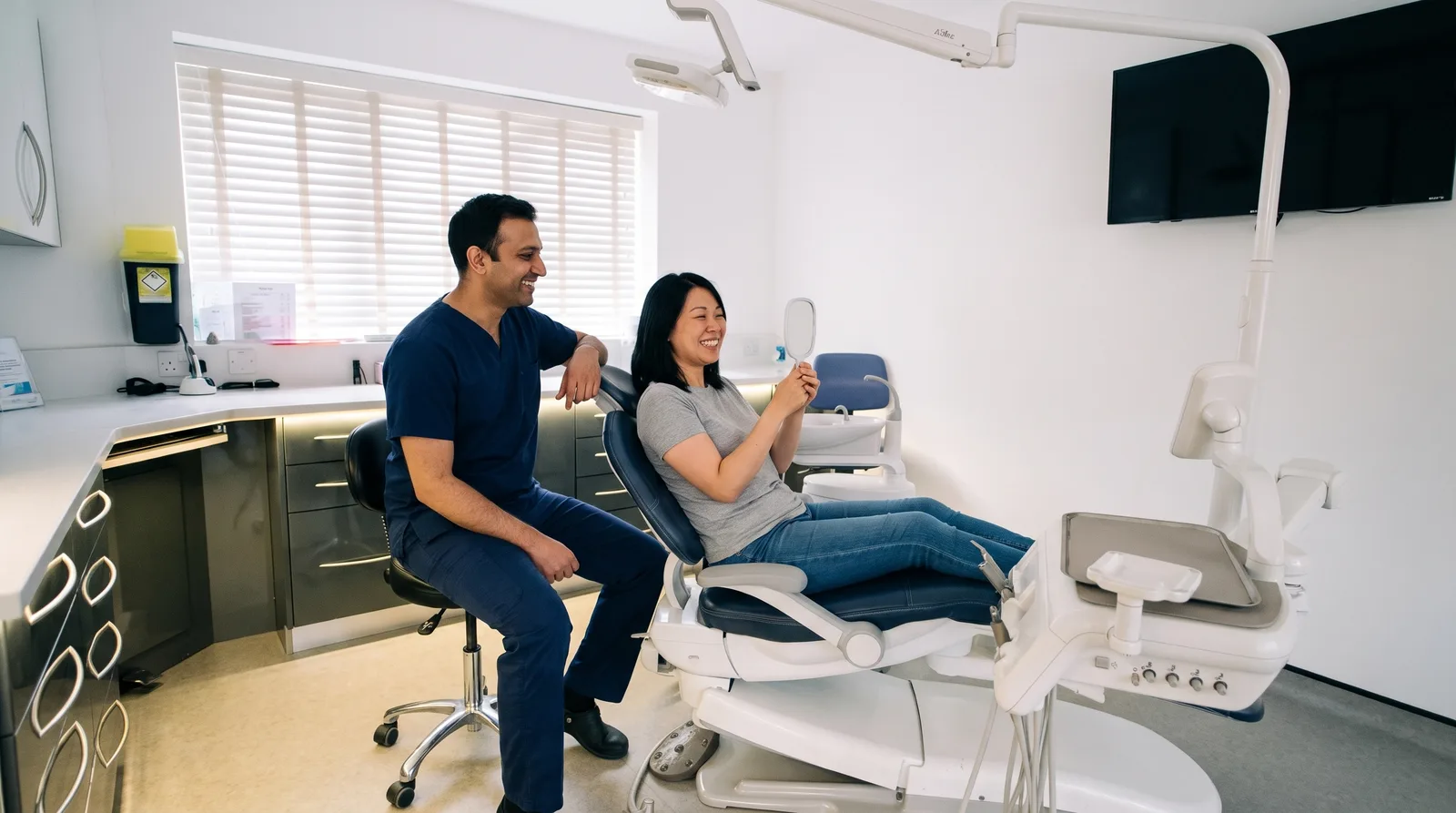
If you sometimes hold back a smile because of how your teeth look, you are far from alone, and you may wonder how much it shows to other people. Research on this mostly asks volunteers to judge photographs, which says something about first impressions and less about real life.
How many people feel self-conscious about their teeth?
The 2021 Adult Oral Health Survey for England, published by the Office for Health Improvement and Disparities in 2024, asked adults aged 16 and over how their teeth, mouth or dentures had affected them in the past 12 months. Being self-conscious was the effect reported most often: 28% of adults said it happened at least occasionally.
A separate question asked how badly problems affected nine everyday activities. Problems smiling, laughing or showing your teeth without embarrassment were the ones most often rated severe, at 12% of adults, ahead of difficulty eating at 9%.
The survey also found a link with the number of natural teeth. Of adults with 1 to 20 natural teeth, 21% reported a severe effect on smiling, laughing or showing their teeth, against 11% of those with 21 or more. Adults who said they had gum disease were also more likely to report severe effects, with the biggest differences for eating and for smiling.
These are self-reported answers from one survey. They measure how common the feeling is and say nothing about its cause. If you are wondering whether smiling itself lifts your mood, our guide to whether smiling makes you happier covers that.
How do other people see teeth?
Researchers often test this by showing volunteers a photograph in which a person’s teeth have been altered on a computer, then asking them to rate that person. Two studies from King’s College London, each using a handful of images of a man or a woman, are typical.
| Study | What volunteers saw | What they rated |
|---|---|---|
| Kershaw, 2008: 180 women | Unaltered, decayed or whitened teeth | Decayed teeth judged less favourably on all four traits, including intellectual ability; whitened teeth judged more favourably |
| Khela, 2020: 232 students | Aligned or crowded teeth, or missing teeth beside the upper front teeth | Aligned teeth rated higher for attractiveness, intelligence and likelihood of dating, and lower for nervousness |
In the 2020 study there was no clear difference in happiness ratings, and none between the crowded and missing-tooth pictures. The 2008 authors suggest their result for decay may be explained by negative beliefs about decay, such as a link with poor oral hygiene.
What the research does not show
Everything above is a volunteer’s rating of an altered picture. A 2020 scoping review from the University of Manchester looked at 16 articles on dental appearance and employment, ten of them experimental simulations. It found that visible dental conditions can lower how people rate job-related characteristics in these simulations. It also said the evidence may not apply to the UK health system, and that a real-life effect on employment had not been demonstrated.
So a photograph study can tell you that teeth may shape a first impression. It cannot tell you what a change to your own teeth would do for you.
Does changing how teeth look change how you feel?
A 2019 systematic review looked at quality of life after whitening and found only four studies that met its criteria. Two showed improvement, one showed a worse result and one was inconclusive. Taken together, they did not show an improvement in overall quality of life.
The pattern within them was mixed. Areas linked to appearance, such as smiling and psychological discomfort, tended to improve. Areas linked to function, such as hygiene and pain, tended to get worse, and the authors name tooth sensitivity as the main side effect. The NHS lists teeth that become sensitive to cold or sweet food and drink, sore gums or throat, and white patches on the gums as possible side effects of whitening by a dental professional. The review covers whitening only, so it cannot tell you how straightening, bonding or veneers would feel.
If you are thinking about whitening, the NHS says it is not available on the NHS, so you pay as a private patient, and a dentist should check that your teeth and gums are healthy first. It says whitening from beauty salons, or with kits bought from a pharmacy or online, does not work as well and may harm your teeth and gums. It is not done if you are 17 or younger. Our teeth whitening guide goes into more detail, and we also have guides to braces for adults and veneers.
When worry about how you look takes over
For some people, worry about how they look, including their teeth, takes up a lot of time. The NHS describes body dysmorphic disorder (BDD) as a mental health condition in which a person spends a lot of time worrying about flaws in their appearance, flaws that are often unnoticeable to others. It lists worrying a lot about one specific area of the body, particularly the face, as one of the signs. It says that having BDD does not mean you are vain or self-obsessed, and that it can seriously affect work, social life and relationships.
The NHS says you should see a GP if you think you might have BDD. You can also refer yourself to an NHS talking therapies service. It says symptoms probably will not go away without treatment and may get worse, but that they can get better with treatment.
If you need urgent help for your mental health, the NHS says to get advice from 111 or ask for an urgent GP appointment. You can get help from 111 online, or call 111 and select the mental health option. The NHS also lists Samaritans, a free listening service, on 116 123. Call 999 or go to A&E if someone’s life is at risk or you do not feel you can keep yourself or someone else safe.
When to see a dentist
- you hold back your smile or cover your mouth because of how your teeth look
- you would like to talk about the colour, shape or position of your teeth, even if nothing hurts
- a tooth has changed colour or shape, or your gums bleed
What we would do
A new patient exam is where we start. We examine your teeth, gums and soft tissues, carry out an oral cancer screening and take small X-rays if they are needed. You can tell the dentist what bothers you, or that nothing does.
If you want to change how your teeth look, our cosmetic dentistry options are teeth straightening, teeth whitening, composite bonding and veneers. Each starts with a consultation. Which one suits you, if any, depends on whether you want to change colour, shape or position. Your dentist assesses whitening first, and veneers need teeth and gums healthy enough to prepare.
Leaving everything as it is can be a fair result of that conversation. If you would like to have it, book a check-up at whichever of our five practices suits you.
Want us to take a look?
Book an appointment at whichever of our five practices suits you. We will check what is going on and talk you through your options.
Questions this guide answers
Do straighter or whiter teeth change how people see you?
In two UK experiments, volunteers rated pictures with whitened teeth more favourably than unaltered ones, and aligned teeth more favourably than crowded ones. These were ratings of photographs, and a 2020 UK review found that real-life effects on employment had not been demonstrated.
Will whitening make me feel better about my smile?
A 2019 review found four studies on this. Taken together they did not show an improvement in overall quality of life, though areas linked to appearance, such as smiling, tended to improve and areas linked to function, such as pain, tended to get worse. The NHS says a dentist should check your teeth and gums first.
Is it normal to feel self-conscious about my teeth?
It is common. In the 2021 Adult Oral Health Survey for England, 28% of adults said their teeth, mouth or dentures had made them self-conscious at least occasionally in the past 12 months. And 12% reported a severe effect on smiling, laughing or showing their teeth without embarrassment.
What if I worry about how I look all the time?
The NHS describes body dysmorphic disorder as a mental health condition in which a person spends a lot of time worrying about flaws in their appearance that are often unnoticeable to others. It says to see a GP if you think you might have it. For urgent help with your mental health, the NHS says to get advice from 111 or ask for an urgent GP appointment, and to call 999 or go to A&E if someone’s life is at risk.
Sources (8)
- Adult oral health survey 2021: self-reported health and oral impacts
- The influence of tooth colour on the perceptions of personal characteristics among female dental patients: comparisons of unmodified, decayed and ‘whitened’ teeth
- The effect of malocclusion on dating prospects
- Does dental appearance impact on employability in adults? A scoping review of quantitative and qualitative evidence
- Vital bleaching and oral-health-related quality of life in adults: a systematic review and meta-analysis
- Teeth whitening
- Body dysmorphic disorder (BDD)
- Where to get urgent help for mental health